
Welcome to Talking Box Genealogy. This blog is written with the intent of documenting my genealogical journey and occasionally providing bits of interesting history and useful genealogical information. I hope that it will prove helpful or entertaining to those who cross paths with it.
Showing posts with label Conwell. Show all posts
Showing posts with label Conwell. Show all posts
Sunday, August 3, 2014
Same blog, new look!
I'm very excited to re-launch Talking Box Genealogy! TBG now has a new look and a new home at http://talkingboxgenealogy.com/. Please update your bookmarks to reflect my new address. RSS feeds can be updated by using http://talkingboxgenealogy.com/feed/. No more posts will be added to this blog so please direct all future interactions to http://talkingboxgenealogy.com/. Thanks for stopping by!

Saturday, July 12, 2014
Life Got in the Way
And don't you just hate it when that happens? I know I do. I've been noticeably absent from posting on my blog because of it. But I definitely haven't been idle. My big project was changing employers. I usually stay away from talking about work because, after all, this is a genealogy blog. But I'm so excited about this new position I just couldn't help but mention that I've moved over to a different association where I'm part of the professional development team...education for public works employees. I've always loved learning new things myself so helping others continue learning is definitely up my alley.
And I haven't been idle on the genealogy front either. Here's what I'm currently working on:
So here's to getting back on the blog-wagon...I can't wait to post some of my recent discoveries!
And I haven't been idle on the genealogy front either. Here's what I'm currently working on:
- I've tried to ramp up working on my sources and citations. Have I mentioned how much I hate citations? I know they're not the big deal I'm making them out to be but I'll admit it, I stress out over whether I'm doing them right. I really need to get a copy of Evidence Explained and read it but it's not in my budget right now unfortunately. So for now I'll continue to try and figure out my citations using Family Tree Maker and the ProGenealogist Genealogy Citation Guides online.
- Speaking of working on my sources, I've been ordering vital records and finds from the North Dakota State University archives as my pocketbook will allow. I've got a surprising amount of documents to save/scan, sort and attach to my tree in Family Tree Maker.
- I dug in and worked hard on my organization one weekend. I'm utilizing the system set out in Eliminating Genealogy Clutter by Sherene Henrie Whiting with one or two tweaks. I think this is a great system but I don't have a lot of room for binders. On the other hand, I have plenty of file cabinet space for hanging folders. I'm not even close to being done but I think I've got a very good start.
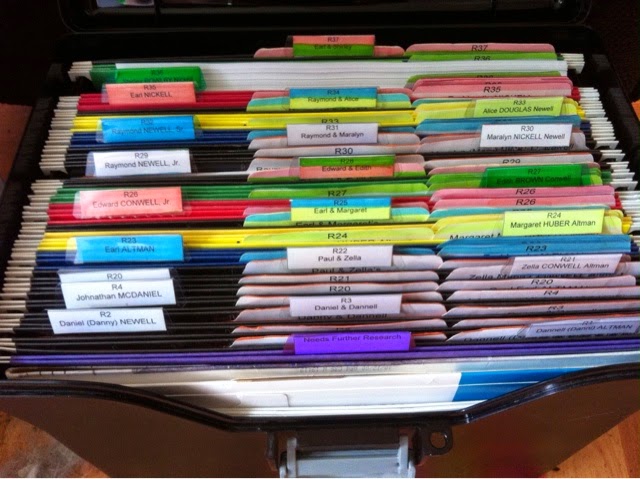 |
| Working hard on my genealogy organization and filing! |
- The spousal unit and I traveled to Iowa and sat down for a day of genealogy and family time with the Iowa family branch. We had fun, shared some genealogy and made some VERY interesting discoveries! Let's just say when my puzzle pieces matched with their puzzle pieces we made a couple of full (or almost full) pictures. It was very exciting.
- I mentioned earlier that I was the recipient of a RAOGK (Random Act of Genealogical Kindness) when a non-relative happened upon some family ephemera and was kind enough to be willing to return it to our family. You can read about that RAOGK here. I was surprised to receive another email from this kind stranger letting me know he'd been contacted by the flea market seller again and had come into possession of one last piece of the family ephemera. I feel very fortunate that he was willing to be the messenger to pass that last piece to me last weekend and a photo of my first cousin (once removed) has returned home.
 |
| A six-year-old Harold Wilkinson returned to the family fold |
- The spousal unit and I also dropped in on the North Dakota family branch and got to spend a little time talking with them...which, for me, inevitably leads to genea-talk. The few hours we had with them turned out to be a few hours too little when we started talking about my father, who passed away a little over a year ago. It's fun to hear stories and thoughts from other family members about the people you love. I haven't talked much about my North Dakota family because I was working on my DAR paperwork (which is on the maternal side and not the paternal side, where the North Dakota connection comes in) but North Dakota has become a very special place for me in the last couple of years thanks to the kindness of family and friends there, so I'm sure you'll be hearing about that side of the family in the future.
So here's to getting back on the blog-wagon...I can't wait to post some of my recent discoveries!
Wednesday, March 12, 2014
Christmas Came Early In Genealogy-land
This past weekend has been an absolute whirlwind of activity and discovery for me. I had to travel to Fort Worth, Texas for work Thursday and Friday and I took the opportunity to go see the Sixth Floor Museum at Dealey Plaza. Dealey Plaza is where President John F. Kennedy was shot in 1963. The Sixth Floor Museum is the former Texas Book Depository building where Lee Harvey Oswald shot JFK from. It was a very interesting site. I also did the walking tour of Dealey Plaza and the surrounding area. I highly recommend both.
As I was sitting in the airport waiting for my flight back Friday night and checking my email to see if there was anything interesting going on, I saw an email from the Registrar of the Daughters of the American Revolution chapter I had applied to join. She was letting me know that my application for the DAR had been approved by National and I would be receiving my paperwork soon! How exciting!!!!! It only took me a few months to gather my documentation and complete my paperwork, from May to December. Luckily my patriot had already been proven through a different branch of the family so I only had to prove back to the son of my patriot, Guian McKee. Guian McKee was a Private serving under Captain James Montgomery and Colonel McKay, Colonel Brodhead and Colonel Bayard. He was from Pennsylvania and most likely somehow related to Colonel McKay. It seems that the name McKay may have morphed into McKee somewhere between Ireland, Scotland and America.
As if that wasn't enough excitement, a few weeks earlier I had been contacted through my blog by a non-relative who had purchased a batch of my family's ephemera from a flea market. I was floored and couldn't imagine how some family items could have ended up in a flea market in Oklahoma. So I went to the only source I could think of that might have some knowledge of how this could have happened. According to the maternal unit, a cousin who lived in Oklahoma had passed away and the children of this cousin had sold off all contents of the shed of the cousin's property without looking through it. And so, the items had ended up with someone unrelated who began researching my family.
I haven't written about this part of my family much simply because I have been working on other parts of my genealogy. Tombstone Tuesday afforded me the opportunity to touch on them briefly when I highlighted my grandparents, Edward Bell Conwell Jr. and Edith M. Brown Conwell. My Tombstone Tuesday post on my grandfather, Edward Jr., is what caught the attention of the gentleman in Oklahoma. What was it about the post that caught his attention? It wasn't Grandpa Edward but his relation to Frank R. Conwell that caught this gentleman's attention. Frank Russell Conwell was my great-uncle. I remember meeting him when I was younger. He was a widower who was living in a trailer in California when I met him. To me, he was a distant relative whom my Grandpa Edward wanted to visit. I was more interested in cool stuff we were seeing while we were traveling to visit Frank than I was in Frank himself. And what a shame that was, since Frank had quite a few interesting experiences I didn't learn about until later.
Frank was born 1 August 1912 in Kansas City, Jackson, Missouri to Edward Bell Conwell, Sr. and Zella May McCabe, who I've been using as guinea pigs in my posts about what you can find on the U.S. census records (so far we've looked at the 1930, 1920, 1910 and 1900 census records. I've also used Zella as a guinea pig for a post on death records and Edward Sr. and Zella as guinea pigs for a post on marriage records). He married Maybelle Victoria "Mabel" Boileau 19 November 1940 in Norwich, New London, Connecticut. They didn't have any children together and Mabel died 27 May 1988 in Jamul, San Diego, California. Frank lived several more years and died 13 April 2001 in El Cahon, San Diego, California and is buried in Greenwood Memorial Park in San Diego, California.
So what makes Frank such an interesting individual that a non-relative would want to learn about him? Frank was a Navy-man, as were his brothers, Edward and Milford. He assisted in the salvage recovery of the U.S.S. Squalus, a submarine that sank off the coast of New Hampshire on May 23, 1939 and he was awarded the Navy Cross for his work on the salvage recovery. And that is what made him such an interesting subject for research. As a child I knew he'd been a Navy diver, but I was never aware that he'd helped salvage the wreckage of a submarine or that he had been honored with a medal. I learned of it when I was older and of the fact that he saved a woman who had fallen overboard while watching the recovery of the Squalus. My family never made a huge deal over these two instances that I can remember. It was just a fact added to our genealogy and accepted as what needed to be done. My family has always just done whatever was necessary to get things done without making a big deal out of it.
Which led me to this past weekend. I made a trip with the most wonderful mother-in-law to pick up all the ephemera which the gentleman from Oklahoma so kindly sold to me.
I'm so excited about these items. Some of them are about my cousin, some about my great-aunt and some about my great-uncle. I've just begun going through and sorting the items but this is one of my favorite.
This is a picture of my great-grandmother, Zella May McCabe (who was married to Edward Bell Conwell, Sr.) It's a picture I've never seen before; I've only seen her as an elderly woman in black and white photographs. She was very beautiful when she was younger and I feel very privileged to have been able to bring this picture back into the family. With all these goodies I've got a lot of work ahead of me to scan, share and preserve them. It feels like Christmas in Genealogy-land!!!! Stay tuned to see some follow up posts on Grandpa Edward, Uncle Frank, Uncle Milford, Aunt Edna and some of the other cousins who are intertwined with these individuals :)
 |
| The former Texas Book Depository Building, now known as the Sixth Floor Museum at Dealey Plaza |
 |
| Dealey Plaza as viewed from the Triple Underpass, the Texas Book Depository Building is on the left behind the trees of the infamous grassy knoll. |
As I was sitting in the airport waiting for my flight back Friday night and checking my email to see if there was anything interesting going on, I saw an email from the Registrar of the Daughters of the American Revolution chapter I had applied to join. She was letting me know that my application for the DAR had been approved by National and I would be receiving my paperwork soon! How exciting!!!!! It only took me a few months to gather my documentation and complete my paperwork, from May to December. Luckily my patriot had already been proven through a different branch of the family so I only had to prove back to the son of my patriot, Guian McKee. Guian McKee was a Private serving under Captain James Montgomery and Colonel McKay, Colonel Brodhead and Colonel Bayard. He was from Pennsylvania and most likely somehow related to Colonel McKay. It seems that the name McKay may have morphed into McKee somewhere between Ireland, Scotland and America.
As if that wasn't enough excitement, a few weeks earlier I had been contacted through my blog by a non-relative who had purchased a batch of my family's ephemera from a flea market. I was floored and couldn't imagine how some family items could have ended up in a flea market in Oklahoma. So I went to the only source I could think of that might have some knowledge of how this could have happened. According to the maternal unit, a cousin who lived in Oklahoma had passed away and the children of this cousin had sold off all contents of the shed of the cousin's property without looking through it. And so, the items had ended up with someone unrelated who began researching my family.
I haven't written about this part of my family much simply because I have been working on other parts of my genealogy. Tombstone Tuesday afforded me the opportunity to touch on them briefly when I highlighted my grandparents, Edward Bell Conwell Jr. and Edith M. Brown Conwell. My Tombstone Tuesday post on my grandfather, Edward Jr., is what caught the attention of the gentleman in Oklahoma. What was it about the post that caught his attention? It wasn't Grandpa Edward but his relation to Frank R. Conwell that caught this gentleman's attention. Frank Russell Conwell was my great-uncle. I remember meeting him when I was younger. He was a widower who was living in a trailer in California when I met him. To me, he was a distant relative whom my Grandpa Edward wanted to visit. I was more interested in cool stuff we were seeing while we were traveling to visit Frank than I was in Frank himself. And what a shame that was, since Frank had quite a few interesting experiences I didn't learn about until later.
Frank was born 1 August 1912 in Kansas City, Jackson, Missouri to Edward Bell Conwell, Sr. and Zella May McCabe, who I've been using as guinea pigs in my posts about what you can find on the U.S. census records (so far we've looked at the 1930, 1920, 1910 and 1900 census records. I've also used Zella as a guinea pig for a post on death records and Edward Sr. and Zella as guinea pigs for a post on marriage records). He married Maybelle Victoria "Mabel" Boileau 19 November 1940 in Norwich, New London, Connecticut. They didn't have any children together and Mabel died 27 May 1988 in Jamul, San Diego, California. Frank lived several more years and died 13 April 2001 in El Cahon, San Diego, California and is buried in Greenwood Memorial Park in San Diego, California.
So what makes Frank such an interesting individual that a non-relative would want to learn about him? Frank was a Navy-man, as were his brothers, Edward and Milford. He assisted in the salvage recovery of the U.S.S. Squalus, a submarine that sank off the coast of New Hampshire on May 23, 1939 and he was awarded the Navy Cross for his work on the salvage recovery. And that is what made him such an interesting subject for research. As a child I knew he'd been a Navy diver, but I was never aware that he'd helped salvage the wreckage of a submarine or that he had been honored with a medal. I learned of it when I was older and of the fact that he saved a woman who had fallen overboard while watching the recovery of the Squalus. My family never made a huge deal over these two instances that I can remember. It was just a fact added to our genealogy and accepted as what needed to be done. My family has always just done whatever was necessary to get things done without making a big deal out of it.
Which led me to this past weekend. I made a trip with the most wonderful mother-in-law to pick up all the ephemera which the gentleman from Oklahoma so kindly sold to me.
 |
| Family items picked up in Tulsa, Oklahoma this past weekend |
I'm so excited about these items. Some of them are about my cousin, some about my great-aunt and some about my great-uncle. I've just begun going through and sorting the items but this is one of my favorite.
 |
| Hand painted picture of Zella May McCabe Conwell |
This is a picture of my great-grandmother, Zella May McCabe (who was married to Edward Bell Conwell, Sr.) It's a picture I've never seen before; I've only seen her as an elderly woman in black and white photographs. She was very beautiful when she was younger and I feel very privileged to have been able to bring this picture back into the family. With all these goodies I've got a lot of work ahead of me to scan, share and preserve them. It feels like Christmas in Genealogy-land!!!! Stay tuned to see some follow up posts on Grandpa Edward, Uncle Frank, Uncle Milford, Aunt Edna and some of the other cousins who are intertwined with these individuals :)
Monday, December 16, 2013
Genealogy Basics: The 1910 Census
Continuing our recent discussion on census records, today we're looking at the 1910 census. The
1910 census was enumerated beginning 15 April 1910. Let's look at the
actual census record to see what information can be extracted from this
census. Using my great-grandpa Edward's census listing, let's look at
what can be discovered about his family:
Edward B. Conwell, Sr. is listed here with his wife, Zella, and children Edward B., Milford, Mildred and Frank. Breaking the census listing down into three parts will help us view the information a little easier:
The first two columns are not numbered but they contain information on the abode:
Columns #1-#2 contain additional information on the abode:
I see that Edward and his family are living on Cyprus Avenue (the street name got partially cut off but it does say Cyprus Avenue). So this is another address that I can go look up to see if the house is still standing. Add that to my list of genealogy things to do.
Column #3 is the name of each person whose place of abode on April 15, 1910, was in this family (surname first, then first name and middle initial if there is one) and column #4 is the relationship of the person to the head of the family:
Columns #5-#11 are personal description data:
This is pretty self-explanatory information, though it does bear mentioning that at this time Edward was 41 (Zella's age on this census is unreadable), married to Zella for 10 years and they had a total of six children, with four still living. This tells me I need to look for some deceased children prior to 1910. Using earlier census records will help me narrow down the years I need to check for those children. Sarah's number of children is also listed so I know she had six but the number still living is unreadable.
Great information to get off this census is the age at last birthday, their marital status and number of years of present marriage, the number of children born and number now living.
Moving on to part #2 of the census record:
Columns #12-#14 are nativity information:
This is also really great information because, if I didn't already have places of birth for each person and their parents, this census provides it. Keep in mind this information is only as good as (1) the person giving the information and (2) the person writing the information down. But it gives you a clue where to look.
This census enumerator has taken the time to list each person's birth location and the birth locations of their parents (as provided by the person providing the census information). As you can see, everyone was U.S. born and most were born in the Midwest in either Kansas, Missouri, Illinois or Ohio.
Columns #15-#16 are citizenship information:
Again, by this time all my family was U.S. born so none of these columns apply.
Column #17 is whether the person is able to speak English or not and if they were not English speaking, the enumerator was asked to list what language they spoke. The entire family was able to speak English.
Moving on to part #3 of the census record:
Columns #18-#22 are occupation information:
From this we can see that Edward Sr. was working but his trade and industry are mostly unreadable. I'm going to have to see if I can find a better copy somewhere. Great-great grandma Sarah was working as a laundress for a private family. They were both working on their own account. Neither one was out of work as of the enumeration date and neither was out of work during 1909.
Columns #23-#25 are education information:
Edward Sr. and Zella are the only ones listed as being able to read and write. Their daughter, Edna, is the only one listed as having attended school that year.
Columns #26-#29 are ownership of home information:
I'm somewhat disappointed that there's no information listed in these columns for Edward and his family. I have no idea if they rented or owned their home in 1910.
The last three columns are kind of interesting bits of information:
I didn't expect to see any information in these columns for my family honestly. I know none of the last columns applied to any of them but column #31 (Union/Confederate military survivor) is great information for genealogists since it gives a clue to military service.
The 1910 census can contain some great information for genealogists. There are several ways to access the census records, from using Ancestry.com (if you don't have a paid subscription to Ancestry, check out your local library or Family History Center for free usage opportunities) for indexed images to using some of the non-indexed sites and paging thru the census record pages one by one. I prefer the indexed version, however, going through page by page can wield treasures of its own. Additional family members have been discovered in this manner and it can also give you a picture of who was living around your ancestor.
Next week: the 1900 census!
 |
| 1910 Census record for Edward Bell Conwell, Sr. and family |
Edward B. Conwell, Sr. is listed here with his wife, Zella, and children Edward B., Milford, Mildred and Frank. Breaking the census listing down into three parts will help us view the information a little easier:
 |
| Section #1 of Edward Bell Conwell, Sr. and family 1910 census record |
The first two columns are not numbered but they contain information on the abode:
- Street, avenue, road, etc. (name)
- House number (in cities or towns)
Columns #1-#2 contain additional information on the abode:
- Number of dwelling house in order of visitation
- Number of family in order of visitation
I see that Edward and his family are living on Cyprus Avenue (the street name got partially cut off but it does say Cyprus Avenue). So this is another address that I can go look up to see if the house is still standing. Add that to my list of genealogy things to do.
Column #3 is the name of each person whose place of abode on April 15, 1910, was in this family (surname first, then first name and middle initial if there is one) and column #4 is the relationship of the person to the head of the family:
- Conwell, Edward B. - head
- Conwell, Zella - wife
- Conwell, Edna M. - daughter
- Conwell, Edward B. - son
- Conwell, Milford R. - son
- Conwell, Mildred A. - daughter
- McCabe, Sarah A. - mother-in-law
Columns #5-#11 are personal description data:
- Sex
- Color or race
- Age at last birthday
- Whether single, married, widowed or divorced
- Number of years of present marriage
- Mother of how many children: Number born
- Mother of how many children: Number now living
This is pretty self-explanatory information, though it does bear mentioning that at this time Edward was 41 (Zella's age on this census is unreadable), married to Zella for 10 years and they had a total of six children, with four still living. This tells me I need to look for some deceased children prior to 1910. Using earlier census records will help me narrow down the years I need to check for those children. Sarah's number of children is also listed so I know she had six but the number still living is unreadable.
Great information to get off this census is the age at last birthday, their marital status and number of years of present marriage, the number of children born and number now living.
Moving on to part #2 of the census record:
 |
| Section #2 of Edward Bell Conwell, Sr. and family 1910 census record |
Columns #12-#14 are nativity information:
- Place of birth of this person
- Place of birth of father of this person
- Place of birth of mother of this person
This is also really great information because, if I didn't already have places of birth for each person and their parents, this census provides it. Keep in mind this information is only as good as (1) the person giving the information and (2) the person writing the information down. But it gives you a clue where to look.
This census enumerator has taken the time to list each person's birth location and the birth locations of their parents (as provided by the person providing the census information). As you can see, everyone was U.S. born and most were born in the Midwest in either Kansas, Missouri, Illinois or Ohio.
Columns #15-#16 are citizenship information:
- Year of immigration to the United States
- Whether naturalized or alien
Again, by this time all my family was U.S. born so none of these columns apply.
Column #17 is whether the person is able to speak English or not and if they were not English speaking, the enumerator was asked to list what language they spoke. The entire family was able to speak English.
Moving on to part #3 of the census record:
 |
| Section #3 of Edward Bell Conwell, Sr. and family 1910 census record |
Columns #18-#22 are occupation information:
- Trade, profession, or particular kind of work done as spinner, salesman, laborer, etc.
- General nature of industry, business, or establishment in which the person works, as cotton mill, dry goods store, farm, etc.
- Whether employer, employee or working on own account
- If an employee: Whether out of work on April 15, 1910
- If an employee: Number of weeks out of work during the year 1909
From this we can see that Edward Sr. was working but his trade and industry are mostly unreadable. I'm going to have to see if I can find a better copy somewhere. Great-great grandma Sarah was working as a laundress for a private family. They were both working on their own account. Neither one was out of work as of the enumeration date and neither was out of work during 1909.
Columns #23-#25 are education information:
- Whether able to read
- Whether able to write
- Attended school any time since September 1, 1909
Edward Sr. and Zella are the only ones listed as being able to read and write. Their daughter, Edna, is the only one listed as having attended school that year.
Columns #26-#29 are ownership of home information:
- Owned or rented
- Owned free or mortgaged
- Farm or house
- Number of farm schedule
I'm somewhat disappointed that there's no information listed in these columns for Edward and his family. I have no idea if they rented or owned their home in 1910.
The last three columns are kind of interesting bits of information:
- Column #31: Whether a survivor of the Union or Confederate Army or Navy
- Column #32: Whether blind (both eyes)
- Column #33: Whether deaf and dumb
I didn't expect to see any information in these columns for my family honestly. I know none of the last columns applied to any of them but column #31 (Union/Confederate military survivor) is great information for genealogists since it gives a clue to military service.
The 1910 census can contain some great information for genealogists. There are several ways to access the census records, from using Ancestry.com (if you don't have a paid subscription to Ancestry, check out your local library or Family History Center for free usage opportunities) for indexed images to using some of the non-indexed sites and paging thru the census record pages one by one. I prefer the indexed version, however, going through page by page can wield treasures of its own. Additional family members have been discovered in this manner and it can also give you a picture of who was living around your ancestor.
Next week: the 1900 census!
Monday, December 9, 2013
Genealogy Basics: The 1920 Census
Today we're continuing the discussion on census records and looking at the 1920 census. The 1920 census was enumerated beginning 1 January 1920. Let's look at the actual census record to see what information can be extracted from this census. Using my great-grandpa Edward's census listing, let's look at what can be discovered about his family:
Edward B. Conwell, Sr. is listed here with his wife, Zella, and children Edward B., Milford, Mildred and Frank. Breaking the census listing down into three parts will help us view the information a little easier:
Columns #1-#4 contain information on the abode:
I see that Edward and his family are still living on Indiana (the street name got partially cut off but it does say Indiana), the street they were living on in 1930 when the census was taken, but they've changed house numbers. So this is another address that I can go look up to see if the house is still standing. Add that to my list of genealogy things to do.
Column #5 is the name of each person whose place of abode on January 1, 1920, was in this family (surname first, then first name and middle initial if there is one) and column #6 is the relationship of the person to the head of the family:
Columns #7-#8 are "tenure" data:
From this we can see that Edward Sr. was renting the home they were in.
Columns #9-#12 are personal description data:
This is pretty self-explanatory information. Great information to get off this census is the age at last birthday and their marital status.
Columns #13-#15 are citizenship information:
Again, by this time all my family was U.S. born so none of these columns apply.
Moving on to part #2 of the census record:
Columns #16-#18 are education information:
The three youngest children all attended school in 1919. Grandpa Edward was 15 at the time this census was taken and it seems was not attending school. I happen to know from verbal history that , like a lot of older children during this time, he was working to help support the family.
Columns #19-#24 are nativity and mother tongue information:
This is also really great information because, if I didn't already have places of birth for each person and their parents, this census provides it. Keep in mind this information is only as good as (1) the person giving the information and (2) the person writing the information down. But it gives you a clue where to look.
This census enumerator has taken the time to list each person's birth location and the birth locations of their parents (as provided by the person providing the census information). As you can see, everyone was U.S. born and most were born in the Midwest in either Kansas, Missouri, Indiana, Illinois or Ohio. It seems, though, that the enumerator didn't complete all the boxes for the mother tongue information. It would be nice if the enumerator was consistent and filled in all the boxes available but that obviously doesn't always happen.
Column #25 is whether the person is able to speak English or not. The entire family was able to speak English.
Moving on to part #3 of the record:
Columns #26-#28 are occupation information:
From this we can see that Edward Sr. was working as a laborer and Edward Jr. was listed as an office boy in a packing house, but column #28 is somewhat confusing. According to the census instructions I located here, the codes for this column were either Em for employer, W for a salary or wage worker and OA for a gainful worker that is neither an employer nor a salary or wage worker. Someone who had no occupation was supposed to have that column left blank. But the enumerator has listed both Edwards as simply "E". Knowing that Grandpa Edward was always an employee and never an employer and seeing that both Edwards were listed as currently working, process of elimination dictates that they were both either salary or wage worker (most likely wage workers) and should have been listed with a "W" in that column.
Column #29 is the number of farm schedule, which doesn't apply to this household.
The 1920 census can contain some great information for genealogists. There are several ways to access the census records, from using Ancestry.com (if you don't have a paid subscription to Ancestry, check out your local library or Family History Center for free usage opportunities) for indexed images to using some of the non-indexed sites and paging thru the census record pages one by one. I prefer the indexed version, however, going through page by page can wield treasures of its own. Additional family members have been discovered in this manner and it can also give you a picture of who was living around your ancestor.
Next week: the 1910 census! And be sure to check back later this week for a very special edition of Around the Town Thursday! I've got a special treat in store :)
 |
| 1920 Census record for Edward Bell Conwell, Sr. and family |
Edward B. Conwell, Sr. is listed here with his wife, Zella, and children Edward B., Milford, Mildred and Frank. Breaking the census listing down into three parts will help us view the information a little easier:
 |
| Section #1 of Edward Bell Conwell, Sr. and family 1920 census record |
Columns #1-#4 contain information on the abode:
- Street of person's abode
- House number or farm
- Number of dwelling house in order of visitation by enumerator
- Number of family in order of visitation by enumerator
I see that Edward and his family are still living on Indiana (the street name got partially cut off but it does say Indiana), the street they were living on in 1930 when the census was taken, but they've changed house numbers. So this is another address that I can go look up to see if the house is still standing. Add that to my list of genealogy things to do.
Column #5 is the name of each person whose place of abode on January 1, 1920, was in this family (surname first, then first name and middle initial if there is one) and column #6 is the relationship of the person to the head of the family:
- Conwell, Edward B. - head
- Conwell, Zella - wife
- Conwell, Edward B. - son
- Conwell, Milford - son
- Conwell, Mildred - daughter
- Conwell, Frank - son
Columns #7-#8 are "tenure" data:
- Home owned or rented
- If owned, free or mortgaged
From this we can see that Edward Sr. was renting the home they were in.
Columns #9-#12 are personal description data:
- Sex
- Color or race
- Age at last birthday
- Single, married, widowed or divorced
This is pretty self-explanatory information. Great information to get off this census is the age at last birthday and their marital status.
Columns #13-#15 are citizenship information:
- Year of immigration to the United States
- Naturalized or alien
- If naturalized, year of naturalization
Again, by this time all my family was U.S. born so none of these columns apply.
Moving on to part #2 of the census record:
 |
| Section #2 of Edward B. Conwell, Sr. and family 1920 census record |
Columns #16-#18 are education information:
- Attended school since 9/11/1919
- Whether able to read
- Whether able to write
The three youngest children all attended school in 1919. Grandpa Edward was 15 at the time this census was taken and it seems was not attending school. I happen to know from verbal history that , like a lot of older children during this time, he was working to help support the family.
Columns #19-#24 are nativity and mother tongue information:
- Place of birth (of person)
- Mother tongue (of person)
- Place of birth (of father)
- Mother tongue (of father)
- Place of birth (of mother)
- Mother tongue (of mother)
This is also really great information because, if I didn't already have places of birth for each person and their parents, this census provides it. Keep in mind this information is only as good as (1) the person giving the information and (2) the person writing the information down. But it gives you a clue where to look.
This census enumerator has taken the time to list each person's birth location and the birth locations of their parents (as provided by the person providing the census information). As you can see, everyone was U.S. born and most were born in the Midwest in either Kansas, Missouri, Indiana, Illinois or Ohio. It seems, though, that the enumerator didn't complete all the boxes for the mother tongue information. It would be nice if the enumerator was consistent and filled in all the boxes available but that obviously doesn't always happen.
Column #25 is whether the person is able to speak English or not. The entire family was able to speak English.
Moving on to part #3 of the record:
 |
| Section #3 of Edward Bell Conwell, Sr. and family 1920 census record |
Columns #26-#28 are occupation information:
- Trade, profession, or particular kind of work done as spinner, salesman, laborer, etc.
- Industry, business, or establishment which at work, as cotton mill, dry goods store, farm, etc.
- Employer, salary worker, wage worker or working on his own account
From this we can see that Edward Sr. was working as a laborer and Edward Jr. was listed as an office boy in a packing house, but column #28 is somewhat confusing. According to the census instructions I located here, the codes for this column were either Em for employer, W for a salary or wage worker and OA for a gainful worker that is neither an employer nor a salary or wage worker. Someone who had no occupation was supposed to have that column left blank. But the enumerator has listed both Edwards as simply "E". Knowing that Grandpa Edward was always an employee and never an employer and seeing that both Edwards were listed as currently working, process of elimination dictates that they were both either salary or wage worker (most likely wage workers) and should have been listed with a "W" in that column.
Column #29 is the number of farm schedule, which doesn't apply to this household.
The 1920 census can contain some great information for genealogists. There are several ways to access the census records, from using Ancestry.com (if you don't have a paid subscription to Ancestry, check out your local library or Family History Center for free usage opportunities) for indexed images to using some of the non-indexed sites and paging thru the census record pages one by one. I prefer the indexed version, however, going through page by page can wield treasures of its own. Additional family members have been discovered in this manner and it can also give you a picture of who was living around your ancestor.
Next week: the 1910 census! And be sure to check back later this week for a very special edition of Around the Town Thursday! I've got a special treat in store :)
Monday, November 25, 2013
Genealogy Basics: The 1930 Census
A couple of weeks ago we started talking about census records and looked at the 1940 census. Today we're continuing to look at census records and the focus is on the 1930 census.
The 1930 census was enumerated beginning 1 April 1930. Let's take a look at an actual census record to see what kind of information can be extracted from this census. Last post we looked at my Grandpa Edward's census listing. I haven't located him in the 1930 census yet but I have a listing for my Great-Grandpa Edward (Grandpa Edward's father) to use for our example:
Edward B. Conwell is listed here with his wife, Zella M., and children, Milford R. and Frank R. As you see, listed below the Conwell family, also living with Grandpa Edward, is his son-in-law John Crouse, daughter and wife of John, Mildred and granddaughter Evelyn J. Breaking the record down into three parts will help us view the information a little easier:
Columns #1-#4 contain information on the abode:
This is great information because I can take the house number and street name and see if that house is still standing to see where my family lived in 1930.
Column #5 is the name of each person whose place of abode on April 1, 1930, was in this family (surname first, then first name and middle initial if there is one) and column #6 is the relationship of the person to the head of the family:
Columns #7-#10 are home data:
From this we can see that Edward Sr. owned their home and it was worth $2,000.00. I can't tell for sure whether they owned a radio or not. The enumerator marked "R" in the columns next to other families who obviously owned radios, but there is an "X" next to Edward Sr.'s census listing so while I suspect they did own a radio, I can't be certain. And further up the census listing, the enumerator indicated "No farms in this block".
Columns #11-#15 are personal description data:
This is pretty self-explanatory information. Great information to get off this census is the age at last birthday because it can help pin down a birth date if you don't already have that and age at first marriage because it can help you pin down a marriage date for the first marriage of the person listed. Keep in mind that if the spouse listed on the census listing isn't the person's first marriage this could cause a little confusion but it can also clue you in to when the first marriage occurred. It's somewhat of a double-edged sword.
Columns #16-#17 are education information:
None of the family attended school that year and all but baby Evelyn were able to read and write, which says a lot about the family since many people still struggled to get a decent education in 1930. Many people had to stop school and go to work to help support their families, resulting in an incomplete education.
Moving to part #2 of the census record:
Columns #18-#20 are information on place of birth:
This is a gold mine of location information. The enumerator has taken the time to list each person's birth location and the birth locations of their parents (as provided by the person providing the census information). As you can see, everyone was U.S. born and most were born in the Midwest in either Kansas, Missouri, Indiana, Illinois or Nebraska.
Column #21 and #21a-c are questions about the person's native language:
Columns #22-#23 are citizenship information:
By this time, this part of my family was all U.S. born so these columns didn't apply.
Column #24 is whether the person is able to speak English or not. The entire family was able to speak English.
Moving on to part #3 of the census record:
Columns #25-#27 are occupation and industry information:
Most of the family worked as laborers, but Zella was working as an operator for some type of factory, Milford was a sales clerk for a grocery store and Frank was working for a nursery. I can't tell where John Crouse was a laborer at, it almost looks like he was a laborer for grading.
Columns #28-#29 are questions about employment:
It seems Edward Sr. was unemployed at some point. Because he was unemployed, he has an additional line number associated with his census line. Unfortunately the FAQs about the 1930 Census indicate the unemployment schedules no longer exist, so any information on this schedule has been lost.
Columns #30-#31 are veteran information:
None of this family served as veterans.
Column #32 is "No. of farm schedule". The farm schedule was a supplemental set of questions for farms and didn't apply to Edward Sr. and his family.
The 1930 census can contain a wealth of information for genealogists. There are several ways to access the census records, from using Ancestry.com (if you don't have a paid subscription to Ancestry, check out your local library or Family History Center for free usage opportunities) for indexed images to using some of the non-indexed sites and paging thru the census record pages one by one. I prefer the indexed version, however, going through page by page can wield treasures of its own. Additional family members have been discovered in this manner and it can also give you a picture of who was living around your ancestor.
The 1930 census was enumerated beginning 1 April 1930. Let's take a look at an actual census record to see what kind of information can be extracted from this census. Last post we looked at my Grandpa Edward's census listing. I haven't located him in the 1930 census yet but I have a listing for my Great-Grandpa Edward (Grandpa Edward's father) to use for our example:
 |
| 1930 Census record for Edward B. Conwell, Sr. and family |
Edward B. Conwell is listed here with his wife, Zella M., and children, Milford R. and Frank R. As you see, listed below the Conwell family, also living with Grandpa Edward, is his son-in-law John Crouse, daughter and wife of John, Mildred and granddaughter Evelyn J. Breaking the record down into three parts will help us view the information a little easier:
 |
| Section #1 of Edward B. Conwell, Sr. and family 1930 census record |
Columns #1-#4 contain information on the abode:
- Street, avenue, road, etc.
- House number (in cities or towns)
- Number of dwelling house in order of visitation
- Number of family in order of visitation
This is great information because I can take the house number and street name and see if that house is still standing to see where my family lived in 1930.
Column #5 is the name of each person whose place of abode on April 1, 1930, was in this family (surname first, then first name and middle initial if there is one) and column #6 is the relationship of the person to the head of the family:
- Conwell, Edward B. - head
- Conwell, Zella M. - wife
- Conwell, Milford R. - son
- Conwell, Frank R. - son
- Crouse, John - son-in-law
- Crouse, Mildred - daughter
- Crouse, Evelyn J. - grand daughter
Columns #7-#10 are home data:
- Home owned or rented
- Value of the home, if owned, or monthly rental, if rented
- Radio set
- Does this family live on a farm?
From this we can see that Edward Sr. owned their home and it was worth $2,000.00. I can't tell for sure whether they owned a radio or not. The enumerator marked "R" in the columns next to other families who obviously owned radios, but there is an "X" next to Edward Sr.'s census listing so while I suspect they did own a radio, I can't be certain. And further up the census listing, the enumerator indicated "No farms in this block".
Columns #11-#15 are personal description data:
- Sex
- Color or race
- Age at last birthday
- Marital condition
- Age at first marriage
This is pretty self-explanatory information. Great information to get off this census is the age at last birthday because it can help pin down a birth date if you don't already have that and age at first marriage because it can help you pin down a marriage date for the first marriage of the person listed. Keep in mind that if the spouse listed on the census listing isn't the person's first marriage this could cause a little confusion but it can also clue you in to when the first marriage occurred. It's somewhat of a double-edged sword.
Columns #16-#17 are education information:
- Attended school or college any time since September 1, 1929
- Whether able to read or write
None of the family attended school that year and all but baby Evelyn were able to read and write, which says a lot about the family since many people still struggled to get a decent education in 1930. Many people had to stop school and go to work to help support their families, resulting in an incomplete education.
Moving to part #2 of the census record:
 |
| Section #2 of Edward B. Conwell, Sr. and family 1930 census record |
Columns #18-#20 are information on place of birth:
- Person
- Father
- Mother
This is a gold mine of location information. The enumerator has taken the time to list each person's birth location and the birth locations of their parents (as provided by the person providing the census information). As you can see, everyone was U.S. born and most were born in the Midwest in either Kansas, Missouri, Indiana, Illinois or Nebraska.
Column #21 and #21a-c are questions about the person's native language:
- 21: Language spoken in home before coming to the United States
- a: (Code) State or MLT
- b: (Code) Country
- c: (Code) blank on the form
Columns #22-#23 are citizenship information:
- Year of immigration to the United States
- Naturalized or alien
By this time, this part of my family was all U.S. born so these columns didn't apply.
Column #24 is whether the person is able to speak English or not. The entire family was able to speak English.
Moving on to part #3 of the census record:
 |
| Section #3 of Edward B. Conwell, Sr. and family 1930 census record |
Columns #25-#27 are occupation and industry information:
- Occupation (trade, profession, or particular kind of work, as spinner, salesman, riveter, etc.)
- Industry (industry or business, as cottonmill, dry goods store, shipyard, public school, etc.)
- Code
- Class of worker
Most of the family worked as laborers, but Zella was working as an operator for some type of factory, Milford was a sales clerk for a grocery store and Frank was working for a nursery. I can't tell where John Crouse was a laborer at, it almost looks like he was a laborer for grading.
Columns #28-#29 are questions about employment:
- Yes or no (whether actually at work)
- Line number for unemployed
It seems Edward Sr. was unemployed at some point. Because he was unemployed, he has an additional line number associated with his census line. Unfortunately the FAQs about the 1930 Census indicate the unemployment schedules no longer exist, so any information on this schedule has been lost.
Columns #30-#31 are veteran information:
- Yes or no (whether a veteran of the U.S. military or naval forces mobilized for any war or expedition)
- What war or expedition
None of this family served as veterans.
Column #32 is "No. of farm schedule". The farm schedule was a supplemental set of questions for farms and didn't apply to Edward Sr. and his family.
The 1930 census can contain a wealth of information for genealogists. There are several ways to access the census records, from using Ancestry.com (if you don't have a paid subscription to Ancestry, check out your local library or Family History Center for free usage opportunities) for indexed images to using some of the non-indexed sites and paging thru the census record pages one by one. I prefer the indexed version, however, going through page by page can wield treasures of its own. Additional family members have been discovered in this manner and it can also give you a picture of who was living around your ancestor.
Monday, November 4, 2013
Genealogy Basics: The 1940 Census
Census records. Every genealogist uses them at one point or another. They're a great source of information as long as you keep in mind the possibility for errors to be found within the census records.
The United States has taken a federal census every 10 years since 1790. The first census enumeration contained a limited amount of information. Each following enumeration asked for a little more information each time. Today we're going to take a look at some information you can find in the census records. Since you always want to start with the latest record available we're going to start with the 1940 census and work our way back.
The 1940 census was enumerated in April. Let's look at a copy of a census record for my family. I know my grandfather was living in Kansas City, Missouri when the 1940 census was enumerated. Here's a copy of the record, broken down into two parts so it's readable:
Columns #1 and #2 are the location information:
The house he's listed at is still standing and I was fortunate to spend summers there growing up as a child.
Columns #3-#6 are household data:
Column #7 is the name of each person who's residence was in the household at the time of enumeration and column #8 is the relationship of the person to the head of household. Grandpa Edward is listed with his (first) wife, Ada J., and...SURPRISE!...mother-in-law, Stella (so if I didn't already know Ada's maiden name, I could have gotten it from this census). Grandpa Edward didn't talk much about his first wife, so I never knew that mother-in-law resided with them.
Columns #9-#12 are the personal description fields:
Columns #13 and #14 are questions regarding education:
Column #15 is the person's place of birth and column #16 is whether the person is a U.S. citizen or foreign born. The whole family was born in Missouri and they were all U.S. citizens. Columns #17-#20 are questions regarding the residence:
Columns #21-#34 are all questions about employment status (for persons 14 years old and over):
The final columns are questions regarding income:
The 1940 census contains a wealth of information for genealogists. There are several ways to access the census records, from using Ancestry.com (if you don't have a paid subscription to Ancestry, check out your local library or Family History Center for free usage opportunities) for indexed images to using some of the non-indexed sites and paging thru the census record pages one by one. I prefer the indexed version, however, going through page by page can wield treasures of its own. Additional family members have been discovered in this manner and it can also give you a picture of who was living around your ancestor.
Have you made any surprising discoveries about your ancestors from the 1940 census? What piece of information are you glad the government included on this census?
Next up, what's on the 1930 census?
The United States has taken a federal census every 10 years since 1790. The first census enumeration contained a limited amount of information. Each following enumeration asked for a little more information each time. Today we're going to take a look at some information you can find in the census records. Since you always want to start with the latest record available we're going to start with the 1940 census and work our way back.
The 1940 census was enumerated in April. Let's look at a copy of a census record for my family. I know my grandfather was living in Kansas City, Missouri when the 1940 census was enumerated. Here's a copy of the record, broken down into two parts so it's readable:
 |
| First half of 1940 census listing for Edward Conwell, Jr. and family |
 |
| Second half of 1940 census listing for Edward Conwell, Jr. and family |
Columns #1 and #2 are the location information:
- Street, avenue, road, etc.
- House number (in cities and towns)
The house he's listed at is still standing and I was fortunate to spend summers there growing up as a child.
Columns #3-#6 are household data:
- Number of household in order of visitation
- Home owned or rented
- Value of home, if owned, or monthly rental, if rented
- Whether the household is on a farm
Column #7 is the name of each person who's residence was in the household at the time of enumeration and column #8 is the relationship of the person to the head of household. Grandpa Edward is listed with his (first) wife, Ada J., and...SURPRISE!...mother-in-law, Stella (so if I didn't already know Ada's maiden name, I could have gotten it from this census). Grandpa Edward didn't talk much about his first wife, so I never knew that mother-in-law resided with them.
 |
| Edward Conwell listed with wife, Ada J., and mother-in-law, Stella Correll |
Columns #9-#12 are the personal description fields:
- Sex
- Color or race
- Age at last birthday
- Marital status
Columns #13 and #14 are questions regarding education:
- Attended school or college since March 1, 1940
- Highest grade of school completed
Column #15 is the person's place of birth and column #16 is whether the person is a U.S. citizen or foreign born. The whole family was born in Missouri and they were all U.S. citizens. Columns #17-#20 are questions regarding the residence:
- The city, town or village having 2,500 or more inhabitants or "R" for all other places
- County
- State or territory/foreign country
- Whether the residence was a farm
Columns #21-#34 are all questions about employment status (for persons 14 years old and over):
- Was this person at work for pay or profit in private or non-emergency government work during the week of March 24-30?
- If not, was this person at work on, or assigned to, public emergency work (WPA, NYA, CCC, etc.) during the week of March 24-30?
- If not at work or assigned to public emergency work were they seeking work?
- If not at work or assigned to public emergency work did they have a job, business, etc.?
- If the person answered no to any of the previous questions, indicate if they were engaged in housework, school, unable to work or other
- If at private or non-emergency government work (from column #21), number of hours worked during the week of March 24-30, 1940
- If seeking work or assigned to public emergency work (from column #22 or #23), duration of unemployment up to March 30, 1940 - in weeks
The final columns are questions regarding income:
- Amount of money wages or salary received (including commissions)
- Did this person receive income of $50 or more from sources other than money wages or salary?
- Number of farm schedule
The 1940 census contains a wealth of information for genealogists. There are several ways to access the census records, from using Ancestry.com (if you don't have a paid subscription to Ancestry, check out your local library or Family History Center for free usage opportunities) for indexed images to using some of the non-indexed sites and paging thru the census record pages one by one. I prefer the indexed version, however, going through page by page can wield treasures of its own. Additional family members have been discovered in this manner and it can also give you a picture of who was living around your ancestor.
Have you made any surprising discoveries about your ancestors from the 1940 census? What piece of information are you glad the government included on this census?
Next up, what's on the 1930 census?
Monday, October 14, 2013
Genealogy Basics: Marriage Certificates
Today we're continuing to talk about vital records. Last week we talked about birth certificates and some of the information you can find on them. This week we're going to talk about marriage records.
If you've been married you know how obtaining a marriage license works. You fill out an application, get the license, the ceremony is performed, license is signed and returned to the state office to be filed. At some point in time, some genealogist, somewhere in the world realized how great of a resource these documents were. Most of the information you'll find will be located on the actual application for the marriage license. Let's take a look at what kind of information we might find on a marriage license:
Another important point to remember: while the majority of licenses filed for were used by the couple, there were instances where the couple filed for the license but never held the ceremony and, therefore, were never legally married. Marriage licenses expired if they weren't used within a certain time period. Keep this in mind if you find the application but never find the filed certificate. I was happy to discover that Edward Sr. and Zella's marriage license had been used and filed and was included with the application when it was digitzed. Below is the copy of their marriage certificate:
So just from this record I was able to learn the names of the bride and groom, their ages, when they were married, who married them, and where they lived when they applied for the license.
Typically these records have not been digitized and have to be requested from the state or county where the marriage occurred. There is usually a fee attached and the fee typically covers the search time and a copy of the record if it's found. Marriage certificates may look different from state to state but the basic information is standard across the states.
Now for an interesting bit of information I discovered after I found this marriage certificate: I learned that my great-grandma Zella was living in Wyandotte County, Kansas when she married my great-grandpa. I always thought they were both living in Jackson County, Missouri. Yay for new and interesting finds!
Tune in next week for information on death certificates!
If you've been married you know how obtaining a marriage license works. You fill out an application, get the license, the ceremony is performed, license is signed and returned to the state office to be filed. At some point in time, some genealogist, somewhere in the world realized how great of a resource these documents were. Most of the information you'll find will be located on the actual application for the marriage license. Let's take a look at what kind of information we might find on a marriage license:
- Full name of bride
- Full name of groom
- Date of marriage
- Location of marriage
- Name of officiant
- Names of witnesses
- Birth date of bride
- Age of bride
- Birth date of groom
- Age of groom
- Whether single, widowed or divorced for each party
- Number of previous marriages for each party
 |
| Application for marriage certificate for Edward Conwell, Sr. and Zella McCabe |
Another important point to remember: while the majority of licenses filed for were used by the couple, there were instances where the couple filed for the license but never held the ceremony and, therefore, were never legally married. Marriage licenses expired if they weren't used within a certain time period. Keep this in mind if you find the application but never find the filed certificate. I was happy to discover that Edward Sr. and Zella's marriage license had been used and filed and was included with the application when it was digitzed. Below is the copy of their marriage certificate:
 |
| Marriage certificate for Edward Conwell, Sr. and Zella McCabe |
So just from this record I was able to learn the names of the bride and groom, their ages, when they were married, who married them, and where they lived when they applied for the license.
Typically these records have not been digitized and have to be requested from the state or county where the marriage occurred. There is usually a fee attached and the fee typically covers the search time and a copy of the record if it's found. Marriage certificates may look different from state to state but the basic information is standard across the states.
Now for an interesting bit of information I discovered after I found this marriage certificate: I learned that my great-grandma Zella was living in Wyandotte County, Kansas when she married my great-grandpa. I always thought they were both living in Jackson County, Missouri. Yay for new and interesting finds!
Tune in next week for information on death certificates!
Monday, September 16, 2013
My Brick Wall: Sarah Ann (Craig) McKee
A brick wall. Every genealogist has one at one time or another. My genealogy is no different. With Constitution Day being this week (September 17 to be exact) my thoughts have been centering on my brick wall. You see, the Daughters of the American Revolution work very hard to celebrate Constitution Week (for obvious reasons) and, as I mentioned previously, I've been working very hard on gathering up genealogical proof for my application to join the DAR. Thus, in a roundabout way, we arrive at my brick wall. So a few basic facts:
Name: Sarah Ann (Craig) McKee (my third great-grandmother)
DOB: 20 February 1830
Place: Tippecanoe, Marshall, Indiana
Parents: William Craig and Katie Helms (nothing further known about parents)
Parents: William Craig and Katie Helms (nothing further known about parents)
Married: Ephraim Adams McKee
Date: 7 December 1848
Place: Danville, Vermilion, Illinois
Death: 13 May 1906
Place: Kansas City, Jackson, Missouri
Children: 6 (5 boys and 1 girl): John William (#1), John William (#2), Sarah Ann, John William (#3), George Washington and Robert Marion.
Children: 6 (5 boys and 1 girl): John William (#1), John William (#2), Sarah Ann, John William (#3), George Washington and Robert Marion.
 |
| Sarah Ann (Craig) McKee Photographer: Unknown Year taken: Unknown |
Now that we have the basic facts that have been proven through census and vital records, let's talk about the "myths and rumors" that haven't been proven yet:
- Sarah Ann (Craig) McKee was married two other times, probably after marrying my 3rd great-grandfather, Ephraim Adams McKee. Her other two husbands were William Coslet and Samuel Coslet (order of marriage unknown); a listing for a marriage between Samuel Coslet and Sarah A. Coslet has been located in the Illinois State Archives Illinois Statewide Marriage Index, 1763-1900 (marriage date of 7 August 1878, five years after the death of Ephraim Adams McKee).
- According to my maternal grandfather, Sarah Ann was of Native American ancestry. Though we're not certain of the tribe, Grandpa Edward always referenced "Tippecanoe and Tyler Too". A little bit of research revealed that "Tippecanoe and Tyler Too" was a campaign slogan for William Henry Harrison and his running mate John Tyler in the 1840 presidential election (information courtesy of "The Meaning of Tippecanoe and Tyler Too"). In short it references Harrison's victory over the Shawnee tribe chief Tecumseh at the Battle of Tippecanoe in 1811.
- Sarah Ann supposedly had enough Native American blood in her that she was granted some land in Mount Washington, Jackson, Missouri. Research on the Bureau of Land Management General Land Office Records website under Jackson County, Missouri has proved fruitless for her name or Ephraim's name, the last name of Coslet or the last name of Craig but did bring up some other McKees. Research on the area known as Mount Washington has turned up that it was the area that is now Mount Washington Cemetery in Independence, Missouri, where several of my family members are buried, including Sarah Ann (Craig) McKee (in a currently unmarked grave) and her daughter Sarah Ann (McKee) McCabe (also currently in an unmarked grave).
- Further research has led me to believe that Sarah Ann could have been a member of either the Shawnee tribe or Potawattomie tribe due to dates and locations of Sarah Ann during her migration trail and the history of the removal of the Pottawatomie Indians from Indiana in 1838 via the Trail of Death (though the timeline is not the same, the migration trail is). Again this could be completely off, as all I have are stories and not much in the way of solid evidence.
- 20 February 1830: Sarah Ann is born in Tippecanoe, Marshall, Indiana
- 7 December 1848: Saran Ann marries Ephraim Adams McKee in Danville, Vermilion, Illinois
- 1860: Sarah Ann is listed in the federal census with husband, Ephraim in Clinton County, Illinois
- 1870: Sarah Ann is listed in the federal census with husband, Ephraim in Vance Township, Vermilion, Illinois
- 16 January 1873: Sarah Ann's husband, Ephraim Adams McKee dies
- 7 August 1878: Sarah Ann possibly marries Samuel Coslet in Douglas County, Illinois
- 1880: a possible listing in the 1880 federal census of a Samuel and Sarah Coslet located in Bowdre Township, Douglas, Illinois
- 1900: a possible listing in the 1900 federal census of a Sarah A. McKee, listed with one son named Edward, located in Allen, Noble, Indiana (I consider this a good possibility because the age is very close and the number of children living is exactly the same, it's questionable because I don't know of any son Edward but since she was married after Ephraim it could be a step-child)
- 13 May 1906: Sarah Ann dies in Kansas City, Missouri
My goal with this post is primarily to put the information out on the WWW in hopes that someone might have some information about Sarah and/or her husband, Ephraim and their daughter Sarah and/or her husband, Chester. Secondly, it's my hope that someone, somewhere might be able to give me suggestions on where to look next to either prove or disprove these myths.
Wow brick walls can be frustrating!
Monday, September 2, 2013
It's Useful to Periodically Review Your Genealogy Documents
So as I said previously, I've fallen off the genealogy bandwagon for a few years due to general life-stuff and have just recently gotten back into actively pursuing leads. Since getting back into active mode I decided to start following some blogs and joining some FaceBook groups to help me with organization, motivation and brick walls. Thanks to The Organized Genealogist FaceBook group I've been actively working on adding citations to my genealogy database (what a mess THAT is, but it'll be worth all the work when I'm done) and organizing my genealogy.
In the process of organizing my e-files I realized that, for the past few years, all I've been doing is collecting genealogy stuff and not categorizing or printing anything at all. Whoa, not really the smartest move I've ever made. So, I decided it was time to do some serious printing and organizing of e-files. For the past few weeks I've been slowly organizing my e-files into family folders on my hard drive, which I will then back up so I have multiple copies. As I've been doing the organization I've also been taking picture files and converting them to TIFF files (which don't have image loss the way JPG files do) and I've also been converting any picture files of census images and other documents to PDF format. After all that is done I then print the document and will work on filing those according to the system I've chosen. (Eliminate Genealogy Clutter by Sherene Henrie Whiting is the system I've chosen in case you're interested...it's a fantastic system!)
Whew! So I'm wading thru this slow process of converting and printing documents last Saturday while D1 was helping his brother and I ran across a rather surprising read. It wasn't surprising so much that I had it (or that I didn't KNOW that I had it), what was surprising was the content I found within it.
 What you see here is an obituary for my 2nd great grandmother (on my maternal side). It's quite a nice obituary, it tells of her longevity in the community, where she lived and who she lived by, some of her thoughts and, of course, where her services and internment will be. But within all of that information resides a couple of pieces that I had forgotten about and one piece that I'd never heard about before and I found very interesting.
After reading this obituary, I recalled that my mother had told me at one time that I had a family member in Topeka, Kansas who was an undertaker. Well either I wasn't listening very well or I'd forgotten what she really told me because it seems that my 2nd great-uncle (Frank Conwell) wasn't just an undertaker, he owned a funeral parlor. The funeral parlor where gg-grandma Margaret's services were held, of course. The other piece of information I recalled after reading this was the fact that my mother had also told me my 2nd great-uncle Frank's second wife, Jennie Finch, was a member of an OES chapter in Topeka. Not just that but also that a photo of my 2nd great-uncle Frank, resides on the wall of a Masonic Lodge in Topeka. I'm going to have to make a trip up there specifically to see that picture I think. And maybe see if I can find where the funeral home was located.
The piece of information in the obituary that I didn't know about was "Mrs. Conwell recalled that she often had trotted Charles Curtis, former vice president of the United States, and his little sister, Libbie Curtis (Mrs. Jerome Colvin) on her knee." Wait. Charles Curtis, former VP of the U.S.? Something started tickling at my brain after I read that. It tickled...and tickled...and tickled until...BAM! I remembered!
A little back story needs to be inserted here: my son, J, is a proud band geek (yep, I raised him right!) and thru my involvement in Eastern Star I learned about the Kansas Masonic All-State High School Marching Band. J participated in this band for five years (and loved every minute of it). His last year participating in the band was 2012. That year the Shrine Bowl, the football game the marching band performs at, was held in Emporia, Kansas. Activities for the Shrine Bowl last all weekend for the families, it's crazy fun and so memorable. So D1 and I are down in Emporia killing time driving around and we end up at a museum in Council Grove, Kansas. The Kaw Mission State Historic Site was a wonderful place to pass the time between events that weekend. While we were touring the Kaw Mission, I ran across the picture and caption below:


At the time I just thought it was pretty interesting that the U.S. had a Vice President that had Native American heritage. Little did I know that later, I would find the obituary for Margaret that connected my family to the former Vice President and his family. I really wish I had gone back thru my genealogy files prior to going to Council Grove. I don't know if the Kaw Mission had any further information on Charles Curtis but it would have been interesting to learn a little more about him if they did.
Since the Curtis family isn't a known part of my family, this is a project I'll be putting on the back burner for now. I have my hands full with working on my paperwork for the Daughters of the American Revolution. My intention is to come back to learning about Charles Curtis after I complete my paperwork for the DAR. I want to learn a little more about his life and see if there's any information about my family included with his family's information.
What this discovery has taught me is that, periodically, it's useful to go back and review your genealogy documents. Take an inventory of what you have and make sure it's in good condition. Re-reading may provide some new and interesting information. You don't catch everything the first or second time you look at something.
In the process of organizing my e-files I realized that, for the past few years, all I've been doing is collecting genealogy stuff and not categorizing or printing anything at all. Whoa, not really the smartest move I've ever made. So, I decided it was time to do some serious printing and organizing of e-files. For the past few weeks I've been slowly organizing my e-files into family folders on my hard drive, which I will then back up so I have multiple copies. As I've been doing the organization I've also been taking picture files and converting them to TIFF files (which don't have image loss the way JPG files do) and I've also been converting any picture files of census images and other documents to PDF format. After all that is done I then print the document and will work on filing those according to the system I've chosen. (Eliminate Genealogy Clutter by Sherene Henrie Whiting is the system I've chosen in case you're interested...it's a fantastic system!)
Whew! So I'm wading thru this slow process of converting and printing documents last Saturday while D1 was helping his brother and I ran across a rather surprising read. It wasn't surprising so much that I had it (or that I didn't KNOW that I had it), what was surprising was the content I found within it.

After reading this obituary, I recalled that my mother had told me at one time that I had a family member in Topeka, Kansas who was an undertaker. Well either I wasn't listening very well or I'd forgotten what she really told me because it seems that my 2nd great-uncle (Frank Conwell) wasn't just an undertaker, he owned a funeral parlor. The funeral parlor where gg-grandma Margaret's services were held, of course. The other piece of information I recalled after reading this was the fact that my mother had also told me my 2nd great-uncle Frank's second wife, Jennie Finch, was a member of an OES chapter in Topeka. Not just that but also that a photo of my 2nd great-uncle Frank, resides on the wall of a Masonic Lodge in Topeka. I'm going to have to make a trip up there specifically to see that picture I think. And maybe see if I can find where the funeral home was located.
The piece of information in the obituary that I didn't know about was "Mrs. Conwell recalled that she often had trotted Charles Curtis, former vice president of the United States, and his little sister, Libbie Curtis (Mrs. Jerome Colvin) on her knee." Wait. Charles Curtis, former VP of the U.S.? Something started tickling at my brain after I read that. It tickled...and tickled...and tickled until...BAM! I remembered!
A little back story needs to be inserted here: my son, J, is a proud band geek (yep, I raised him right!) and thru my involvement in Eastern Star I learned about the Kansas Masonic All-State High School Marching Band. J participated in this band for five years (and loved every minute of it). His last year participating in the band was 2012. That year the Shrine Bowl, the football game the marching band performs at, was held in Emporia, Kansas. Activities for the Shrine Bowl last all weekend for the families, it's crazy fun and so memorable. So D1 and I are down in Emporia killing time driving around and we end up at a museum in Council Grove, Kansas. The Kaw Mission State Historic Site was a wonderful place to pass the time between events that weekend. While we were touring the Kaw Mission, I ran across the picture and caption below:


 |
| Charles Curtis display at the Kaw Mission State Historic Site in Council Grove, Kansas |
Since the Curtis family isn't a known part of my family, this is a project I'll be putting on the back burner for now. I have my hands full with working on my paperwork for the Daughters of the American Revolution. My intention is to come back to learning about Charles Curtis after I complete my paperwork for the DAR. I want to learn a little more about his life and see if there's any information about my family included with his family's information.
What this discovery has taught me is that, periodically, it's useful to go back and review your genealogy documents. Take an inventory of what you have and make sure it's in good condition. Re-reading may provide some new and interesting information. You don't catch everything the first or second time you look at something.
Subscribe to:
Posts (Atom)