Showing posts with label Masons. Show all posts

Monday, September 2, 2013

It's Useful to Periodically Review Your Genealogy Documents

So as I said previously, I've fallen off the genealogy bandwagon for a few years due to general life-stuff and have just recently gotten back into actively pursuing leads.  Since getting back into active mode I decided to start following some blogs and joining some FaceBook groups to help me with organization, motivation and brick walls.  Thanks to The Organized Genealogist FaceBook group I've been actively working on adding citations to my genealogy database (what a mess THAT is, but it'll be worth all the work when I'm done) and organizing my genealogy.

In the process of organizing my e-files I realized that, for the past few years, all I've been doing is collecting genealogy stuff and not categorizing or printing anything at all.  Whoa, not really the smartest move I've ever made.  So, I decided it was time to do some serious printing and organizing of e-files.  For the past few weeks I've been slowly organizing my e-files into family folders on my hard drive, which I will then back up so I have multiple copies.  As I've been doing the organization I've also been taking picture files and converting them to TIFF files (which don't have image loss the way JPG files do) and I've also been converting any picture files of census images and other documents to PDF format.  After all that is done I then print the document and will work on filing those according to the system I've chosen. (Eliminate Genealogy Clutter by Sherene Henrie Whiting is the system I've chosen in case you're interested...it's a fantastic system!)

Whew!  So I'm wading thru this slow process of converting and printing documents last Saturday while D1 was helping his brother and I ran across a rather surprising read.  It wasn't surprising so much that I had it (or that I didn't KNOW that I had it), what was surprising was the content I found within it.

What you see here is an obituary for my 2nd great grandmother (on my maternal side).  It's quite a nice obituary, it tells of her longevity in the community, where she lived and who she lived by, some of her thoughts and, of course, where her services and internment will be.  But within all of that information resides a couple of pieces that I had forgotten about and one piece that I'd never heard about before and I found very interesting.

After reading this obituary, I recalled that my mother had told me at one time that I had a family member in Topeka, Kansas who was an undertaker.  Well either I wasn't listening very well or I'd forgotten what she really told me because it seems that my 2nd great-uncle (Frank Conwell) wasn't just an undertaker, he owned a funeral parlor.  The funeral parlor where gg-grandma Margaret's services were held, of course.  The other piece of information I recalled after reading this was the fact that my mother had also told me my 2nd great-uncle Frank's second wife, Jennie Finch, was a member of an OES chapter in Topeka.  Not just that but also that a photo of my 2nd great-uncle Frank, resides on the wall of a Masonic Lodge in Topeka.  I'm going to have to make a trip up there specifically to see that picture I think.  And maybe see if I can find where the funeral home was located.

The piece of information in the obituary that I didn't know about was "Mrs. Conwell recalled that she often had trotted Charles Curtis, former vice president of the United States, and his little sister, Libbie Curtis (Mrs. Jerome Colvin) on her knee."  Wait.  Charles Curtis, former VP of the U.S.?  Something started tickling at my brain after I read that.  It tickled...and tickled...and tickled until...BAM!  I remembered!

A little back story needs to be inserted here: my son, J, is a proud band geek (yep, I raised him right!) and thru my involvement in Eastern Star I learned about the Kansas Masonic All-State High School Marching Band.  J participated in this band for five years (and loved every minute of it).  His last year participating in the band was 2012.  That year the Shrine Bowl, the football game the marching band performs at, was held in Emporia, Kansas.  Activities for the Shrine Bowl last all weekend for the families, it's crazy fun and so memorable.  So D1 and I are down in Emporia killing time driving around and we end up at a museum in Council Grove, Kansas.  The Kaw Mission State Historic Site was a wonderful place to pass the time between events that weekend.  While we were touring the Kaw Mission, I ran across the picture and caption below:


Charles Curtis display at the Kaw Mission State
Historic Site in Council Grove, Kansas
At the time I just thought it was pretty interesting that the U.S. had a Vice President that had Native American heritage.  Little did I know that later, I would find the obituary for Margaret that connected my family to the former Vice President and his family.  I really wish I had gone back thru my genealogy files prior to going to Council Grove.  I don't know if the Kaw Mission had any further information on Charles Curtis but it would have been interesting to learn a little more about him if they did.

Since the Curtis family isn't a known part of my family, this is a project I'll be putting on the back burner for now.  I have my hands full with working on my paperwork for the Daughters of the American Revolution.  My intention is to come back to learning about Charles Curtis after I complete my paperwork for the DAR.  I want to learn a little more about his life and see if there's any information about my family included with his family's information.

What this discovery has taught me is that, periodically, it's useful to go back and review your genealogy documents.  Take an inventory of what you have and make sure it's in good condition. Re-reading may provide some new and interesting information.  You don't catch everything the first or second time you look at something.

Thursday, August 1, 2013

Around the Town Thursday - Herman E. Laird Park

Today's Around the Town Thursday post focuses on a location not far from my house.  I can't recall the number of times I've driven past Herman E. Laird Park without stopping.  

Herman E. Laird Park is located in Shawnee, Kansas

There are many wonderful aspects of the park: tennis courts, a playground, a picnic area and at the edge of the park boundaries sits Old Shawnee Town, a prominent Shawnee, Kansas living history site but the portion of the park I'm choosing to focus on for this post is a statue in the corner of the park.  You can see the statue while driving on Johnson Drive, the main thoroughfare the park sits on.  And I've always wondered what the purpose of the statue was, so I decided to find out.


Statue at the corner of Herman E. Laird Park in Shawnee, Kansas

What I discovered is that the statue is a tribute statue.  The statue is titled "Taking Time" and is a tribute to Chief Charles Bluejacket.  When I moved to the area I looked at a school named Bluejacket-Flint but when you're researching schools to send your kid to you don't think too much of where the school's name came from so this was pretty interesting to discover that there was a statue to a man by the name of Bluejacket, which just happened to not be far from a school by the name of Bluejacket.  Go figure ;)


The plaque in front of the statue gives visitors a basic idea of who Chief Charles Bluejacket was.  Shawnee tribal chief, military captain, farmer, minister and interpreter.  But that's never the whole story, is it?

Charles Bluejacket was born on the banks of the Huron River in Michigan in 1817.  His family moved to Piqua, Ohio soon after his birth and his early education was received from a Quaker School in Piqua.  Following the family's move to Kansas in 1833 (part of the Indian removal), his education continued in mission schools in Kansas.  He also farmed and did missionary work with the Shawnees for the Methodist church.  He was a student of the Shawnee culture and worked hard to pass the customs and teachings of the Shawnee to others.  Bluejacket eventually became a Methodist minister and joined a local Masonic Lodge in Shawnee.


In the years leading up to the Civil War, Bluejacket became a successful farmer, trusted interpreter for the government, and well-respected local businessman and leader.  He eventually became chief of the Shawnee Tribe during the period of time when Kansas became a state and the Civil War broke out.  There is a very interesting essay here that talks about Charles Bluejacket and has an interesting bit about his daughter-in-law defending herself and her home against one of Quantrill's raiders.  It's well worth the read (and if the story is true, I confess, I wouldn't mind meeting Bluejacket's daughter-in-law!).  Bluejacket served as chief of the Shawnee Tribe for three years.  Soon after, the Indians were once again removed from their lands, this time into Oklahoma in 1869.

Bluejacket's story doesn't stop with his move to Indian Territory.  He was a natural born leader and the location he settled near in Oklahoma eventually became a bustling community, thanks to the railroad.  A post office was opened bearing his name in 1882 with Bluejacket serving as postmaster.  He also served as the Methodist minister in that locale for a time.  When the town finally became incorporated, the name Blue Jacket was chosen for the town.

Artist Charles Goslin has portrayed Bluejacket
reading to two of his twenty-three children.
The love of a father for his children and of
children for their father is evident in the
sculpture.

The park statue shows Bluejacket reading to two of his twenty-three children.  It's said he enjoyed spending time reading to his children.  In my research I discovered that near his death, he made a trip back to Kansas City from Oklahoma to try and find the grave of The Prophet Tecumseh.  He was unsuccessful in finding the grave as he became ill.  Returning to his home in Oklahoma, he soon passed away and was buried in the Blue Jacket, Oklahoma cemetery; on land which he donated to the Methodist church with full Masonic service.  His funeral was among the largest ever seen in that area.  I believe I'd like to visit Blue Jacket, Oklahoma one day and visit Chief Bluejacket's gravesite.  Everything I've read has indicated Chief Bluejacket to be a kind, generous, intelligent and honorable man.  How great to think he lived in my area.


As a side note, in my research, I also ran across information stating that Chief Bluejacket's father (who was a prominent war chief for the Shawnee Tribe) was actually a white man by the name of Marmaduke Van Swearingen who had been born in Virginia, abducted as a teenager and indoctrinated into the Shawnee Tribe.  It's highly likely that this is nothing more than a myth, as DNA testing has been done on descendants of both Van Swearingen and Bluejacket and the DNA doesn't match.

Tuesday, July 30, 2013

Tombstone Tuesday - Edward Bell Conwell, Jr.

Welcome to another edition of Tombstone Tuesday!

Today we're not straying very far from last week's tombstone.  It belongs to my maternal grandfather, Edward Bell Conwell, Jr.  Edward was the second of eight children of Edward Bell Conwell, Sr. and Zella May (McCabe) Conwell.  He had five brothers (one older, four younger) and two sisters (one older, one younger).

Edward was born 23 April 1904 in Kansas City, Jackson, Missouri and died 18 March 2000 in Atlantic, Cass, Iowa.  He is buried in between his first wife, Ada Jane (Correll) Conwell, and his second wife, Edith Marie (Brown) Conwell (my grandmother) in Mount Washington Cemetery in Independence, Jackson, Missouri.  He was a fifty year member of the Masons (A.F. & A.M.) and served in the U.S. Navy for a period of time, receiving a medical discharge for stomach issues.

Thanks for stopping by!


Monday, July 22, 2013

An interesting find

I love going to estate sales. Some people might find it a little creepy to go sorting through the personal items of someone who's deceased but I've discovered many interesting treasures at estate sales. It shocks and disturbs me to see family pictures and possible heirlooms being sold and I'm heartbroken that I'm not always able to afford to purchase these items and re-home them.

D1, most wonderful mother-in-law and I recently stopped at a not-so-extraordinary looking estate sale and as I was browsing the items for sale I happened across this book in a box of items marked at $0.50. 


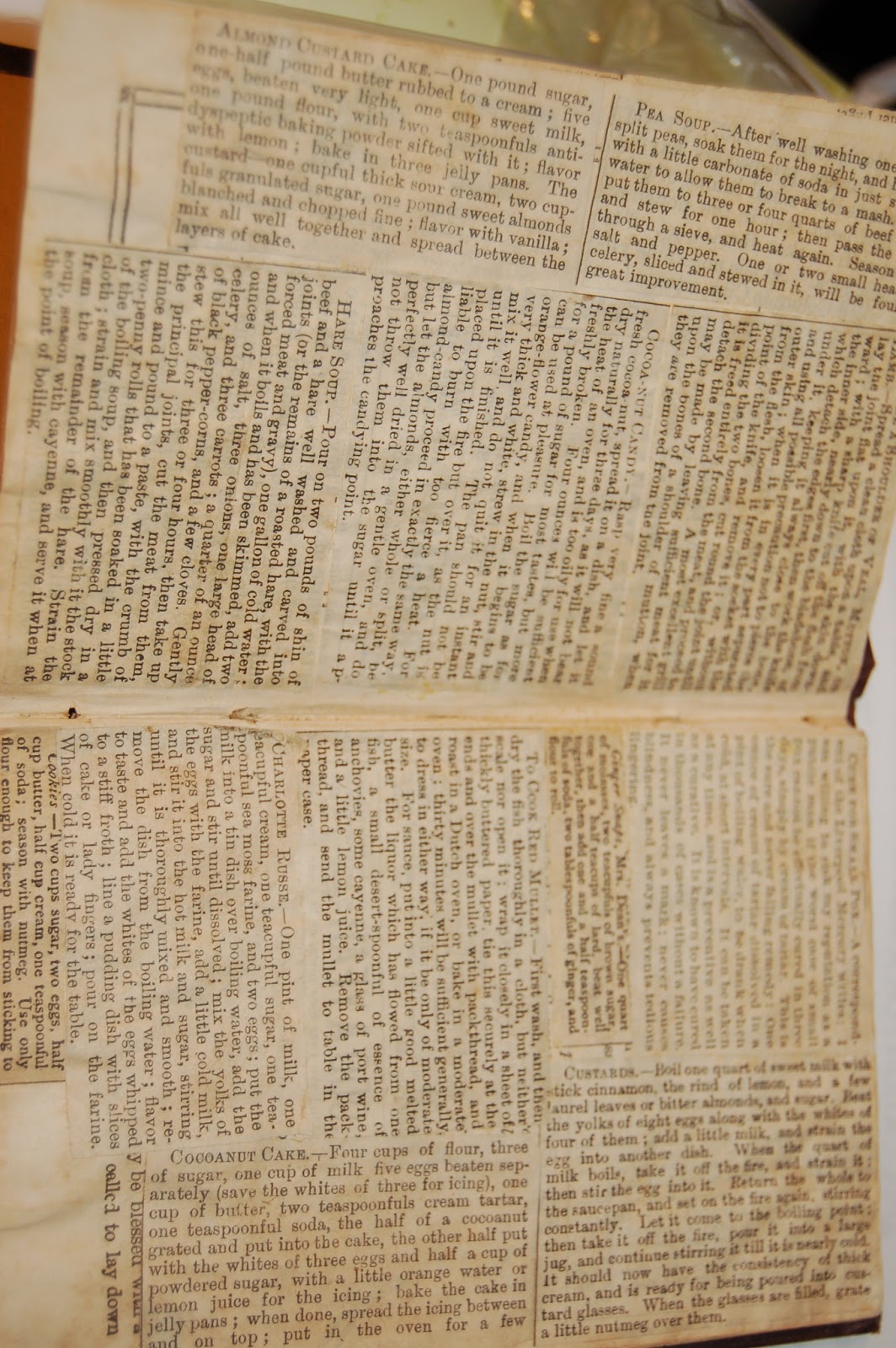
The book is obviously old and I thought it had an interesting look to it so I began to peruse the aged and well-worn pages.  The first couple of pages had been pasted over with recipes, which was somewhat disappointing because the title page had been pasted over so I couldn't see what the book's title was.


As I got further into the book I realized I was looking at a ritual for some type of fraternal organization. I knew this because I'm a member of a similar fraternal organization and the ritual read similar but wasn't quite what I had at home so I knew it wasn't an Eastern Star ritual. After showing it to D1 he confirmed it wasn't a Masonic ritual. 

Hmmmm, a mystery. I do love a good mystery. I must have stood in the bedroom of this house for 10 minutes or more looking at this book before I found something I could search the Internet for to help me identify what organization this book was a part of.  And what D1 and I discovered was very interesting indeed. 


The book I'd found was a ritual for a fraternal organization called The Order of the Patrons of Husbandry, also known as The Grange.  It was an organization I'd never heard of before which was equally as intriguing for me.  As I read about what D1 had found on his handy dandy smart phone and paged through the book I ended up back at the front of the book and discovered something I had missed on the inside of the front cover.


The information on the inside front cover of the book shed a whole new light on the ritual.  This wasn't just an interesting piece of history, this was someone else's genealogy.  Somewhere I'm betting Miss Sarah A. Campbell from Parkville, Platte, MO has some distant relatives who might be interested to know that she was a member of this fraternal organization.  Why might this be interesting to a relative?  Fraternal organizations weren't just a way for people to be social.  They were avenues for businessmen to do business, a way to pass news from town to town, and a way for new settlers to build roots in a new community they settled in.  Having roots in a community was especially important when you're looking at areas that weren't fully settled yet.  Neighbors relied on neighbors, friends and relatives to assist them bringing in harvests, building barns and other large projects in largely unsettled areas.


There is no guarantee that a fraternal organization will release information on an ancestor, but it never hurts to inquire.  Many of them may not have the staff, resources or time to give much more information than a yes they belonged or no they didn't and what chapter the ancestor was a member of.  There might also be issues about releasing personal information, even if the person is deceased.  However, you don't know unless you try so this amateur genealogist says give it a go and see where you get!  I personally have requested information from the Grand Lodge of A.F. & A.M. and have received a wonderful bit of information on my grandfather that I was able to add to my genealogy.  What can I do with that information?  For me, not a lot but it was something I could add to my genealogical database and something I found interesting.  However!  If this was an ancestor I didn't know much about, it would be a different story.

Let's just say I didn't know much about my grandfather and I found out, by way of the emblem on his tombstone, that he was a Mason.  I did a little research, discovered the Grand Lodge website of the state where my grandfather is buried and decided to contact them to see if they'd give me any information.  So I use their contact me page to send them a brief inquiry (very important, as brief as possible is good with the basic facts you know about the person; make sure you give them enough information to actually do a look up though.  Remember, there are a LOT of Smiths in ANY database) requesting to know if they have any information on an Edward B. Conwell, Jr. who was buried in Kansas City, Missouri.  I make sure to thank them in advance for their time, hit the send button, and wait.  A few days later I open up my email to find a response from the Grand Lodge of Missouri.  Hooray!  A match to my inquiry has been found.  So what information did I get?  Just basics: his name, what Lodge he was a member of and the location of that Lodge, that he was a member in good standing at the time of his death (meaning he paid his dues) and that he was a fifty-year member.  Whoa.  So I now know the neighborhood he attended meetings in, which could potentially help me place where he lived and I know that he was a fifty-year member, which could help me pin down dates that I might not otherwise know, like a birth year.

Obviously I knew the death date because I said I had seen the emblem on his tombstone.  And I knew he was a fifty-year member when he died.  So, if I didn't know his death date I could do the math and get pretty close to determining his birth year.  I say pretty close because what you need to understand is, although I got the information that he was a fifty-year member, that doesn't mean it was EXACTLY fifty-years.  Many organizations will make a big deal about being a long-standing member.  They won't necessarily make a big deal about your fifty-first or fifty-fifth year in the organization.  Twenty-five, fifty and seventy-five are typically the numbers they'll note in their records.  Also keep in mind that different fraternal organizations have different age requirements for joining.  The Masonic order is 18 but other organizations have different age requirements.  But it will give you somewhere to go with that information.

Remember that dates and locations are always great finds, no matter how small or insignificant you believe them to be at the time.  You never know when that small piece of information you found might tear down a brick wall you've been staring at.  Besides the facts, information you might get about your ancestor's involvement in a fraternal organization, in my experience, helps to give life to that ancestor and show that they weren't just a stack of statistics.  They were real people who got involved in their communities and cared about things happening around them.

If you're still curious about The Grange, The Conner Prairie Interactive History Park has a great history of it here.  The National Grange of the Order of the Patrons of Husbandry is still an active organization and they're official history page is here.  I was both saddened to see that Miss Campbell's Grange in Parkville no longer exists and tickled to discover an active Grange not that far from my location. I wish I could find Miss Campbell's family so I could pass her ritual back into the family fold, but since I don't have much more than a name and location I'll contact the local Grange and see if they're interested in the book.  I'd like to see this bit of history preserved because it was such an interesting read and a fun little side investigation for me.