Showing posts with label KC. Show all posts

Monday, November 11, 2013

Lest We Forget: The Poppy

Today is Veterans Day and today's post is dedicated to all those who have served and all those who are currently serving.  Thank you all for your service and sacrifice!

Today being Veterans Day, you may notice that some people are wearing poppies today.  Do you know the significance of the poppy on Veterans Day?  Originally, the poppies were only worn on Memorial Day but many groups have opted to also wear the poppies on Veterans Day (also known as Remembrance Day).  Veterans Day honors all those who served in the military, whether in wartime or in peacetime.  It falls on the day the World War I hostilities officially ended, "at the 11th hour of the 11th day of the 11th month" in 1918.  But why poppies?

The significance of the poppy goes back to World War I and the poem "In Flanders Fields" written in 1915 by Lieutenant Colonel John McCrae, a Canadian physician who served during World War I.  McCrae wrote the poem after presiding over the funeral of a friend and comrade.

In Flanders Fields the poppies blow
Between the crosses, row on row
That mark our place; and in the sky
The larks, still bravely singing, fly
Scarce heard amidst the guns below

We are the Dead.  Short days ago
We lived, felt dawn, saw sunset glow,
Loved, and were loved, and now we lie
In Flanders fields.

Take up our quarrel with the foe:
To you from failing hands we throw
The torch; be yours to hold it high
If ye break faith with us who die
We shall not sleep, though poppies grow
In Flanders fields.

Flanders fields refer to World War I battlefields in an area near Belgium which is now known as West Flanders, East Flanders and part of the French region of Nord-Pas-de-Calais.  The Second Battle of Ypres occurred here, which is the battle that McCrae's friend died in and helped to prompt the writing of "In Flanders Fields".  After all the devastation on these battlefields in World War I, poppies began to bloom in the battlefields.  The only thing that could survive in the devastation, the poppies were able to bloom due to the fact that they are a plant that thrives on disturbed ground.  The seeds lie dormant until the soil is broken up, and then the flowers take root and begin to grow.

After writing the poem, it was submitted to newspapers in England.  It was rejected by The Spectator but published by Punch on 8 December 1915.  The poem was read by Moina Michael, an U.S. professor and humanitarian, who was so moved that she wrote the poem "We Shall Keep the Faith" in reply to McCrae's poem:

Oh! you who sleep in Flanders Fields,
Sleep sweet - to rise anew!
We caught the torch you threw
And holding high, we keep the Faith
With All who died.

We cherish too, the Poppy red
That grows on fields where valor led;
It seems to signal to the skies
That blood of heroes never dies,
But lends a lustre to the red
Of the flower that blooms above the dead
In Flanders Fields.

And now the Torch and Poppy Red
We wear in honor of our dead.
Fear not that ye have died for naught;
We'll teach the lesson that ye wrought
In Flanders Fields.
In Flanders Fields we fought.

According to the American Legion Auxiliary Poppy site, in November 1918 on an impulse, Moina Michael purchased all the poppies that New York City's Wanamaker's Department Store had in the store and handed them to businessmen meeting at the YMCA where she worked and asked them to wear the poppy as a tribute to the fallen.  The idea of selling silk poppies is credited to Michael as a way to raise funds to assist disabled veterans.  In 1921, the American Legion Auxiliary adopted the poppy as a symbol of remembrance for war veterans.

And now you know the story of the poppy.

Lest we forget.

Thursday, November 7, 2013

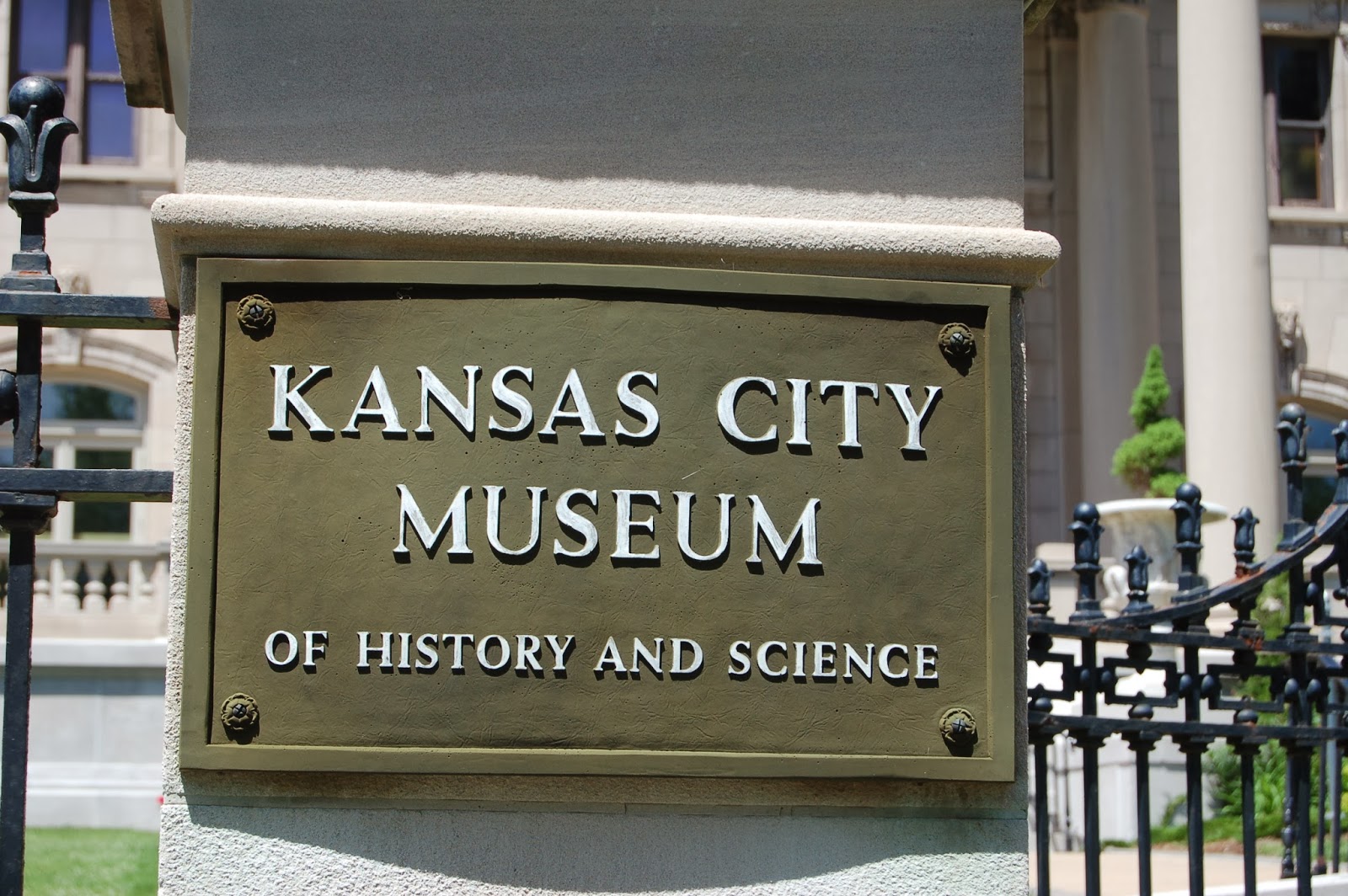
Around the Town Thursday: Kansas City Museum at Corinthian Hall

It's Thursday and time for another edition of Around the Town Thursday.  In the spotlight today is a historic building that's very near and dear to my heart: Corinthian Hall.

South facade (front) of Corinthian Hall

Porte cochere with bronze and wire glass canopy

Many local residents might know this building as the Kansas City Museum of History and Science, which it did house for many years.  


Many Kansas Citians may remember such icons as the igloo on the third floor, the covered wagon on the first floor and the tepee display on the first floor of the museum.  And who could forget the Natural History Hall housed in the carriage house which was full of stuffed animals contained in lifelike dioramas of natural habitats of each animal.  I'm sure many of us remember the bear at the end of the hall!

But what many visitors of this hallowed institution may not know is the fabulous history of this building and its residents.  Kansas City has a wonderful history tied directly to the builder of this home: Robert A. Long.

Robert A. Long was many things but he's most well-known in the Kansas City area for being a lumber baron, philanthropist and driving force behind the Liberty Memorial (now known as the National World War I Museum at the Liberty Memorial).  He was also instrumental in the building of several other buildings in downtown Kansas City, Missouri.

According to the Friends of Kansas City Museum at Corinthian Hall website, "Corinthian Hall, one of Kansas City's larges and most well-known residences, began its life not as a plan for a mansion, but as a plan for a stable."  According to Robert Long's daughter, Loula Long Combs, Robert saw the need for a new stable and decided the family should also have a new home to go with it.  That decision lead to the creation of Corinthian Hall.  Referred to as Corinthian Hall because of the six Corinthian columns located in the front of the house, Corinthian Hall boasted approximately 50,000 square feet of space which was broken down into three floors containing approximately 70 rooms and closets, 15 bathrooms, nine fireplaces, an attic and a basement containing a full-length bowling alley.  The home was completed in 1910 and the Long family resided there until Robert Long's death in 1934.

The building is absolutely gorgeous on the outside and inside.  Right now, with the restoration going on, you have to enter the grounds from the North side of the grounds.  But oh!  What an entrance.  If you happen to go during the spring and summer the wisteria may very well be in bloom on the pergolas and its so pleasant to just be able to sit on a stone bench, under the wisteria-covered pergolas and enjoy the shade and beauty of the grounds.

North entrance of the grounds partially showing the pergola and wisteria

Pergola and wisteria at Corinthian Hall

Access to Corinthian Hall is currently restricted to hard hat and guided exhibit tours.  I can't recommend the hard hat tour enough.  It's a great tour and gives visitors a great deal of insight into the history and current renovations going on.  You can see where the renovations stand now, hear about previous phases of the renovations and learn about future plans for the museum.  The stained glass, original walls and floors, grand staircase and other fancy bits are a beauty to behold, even now during renovations.  One can only imagine what the grandeur might be like when the renovations are complete.  Information on the hard hat tours can be found here.

Grand Staircase

Beautiful stained glass window at the top of the Grand Staircase

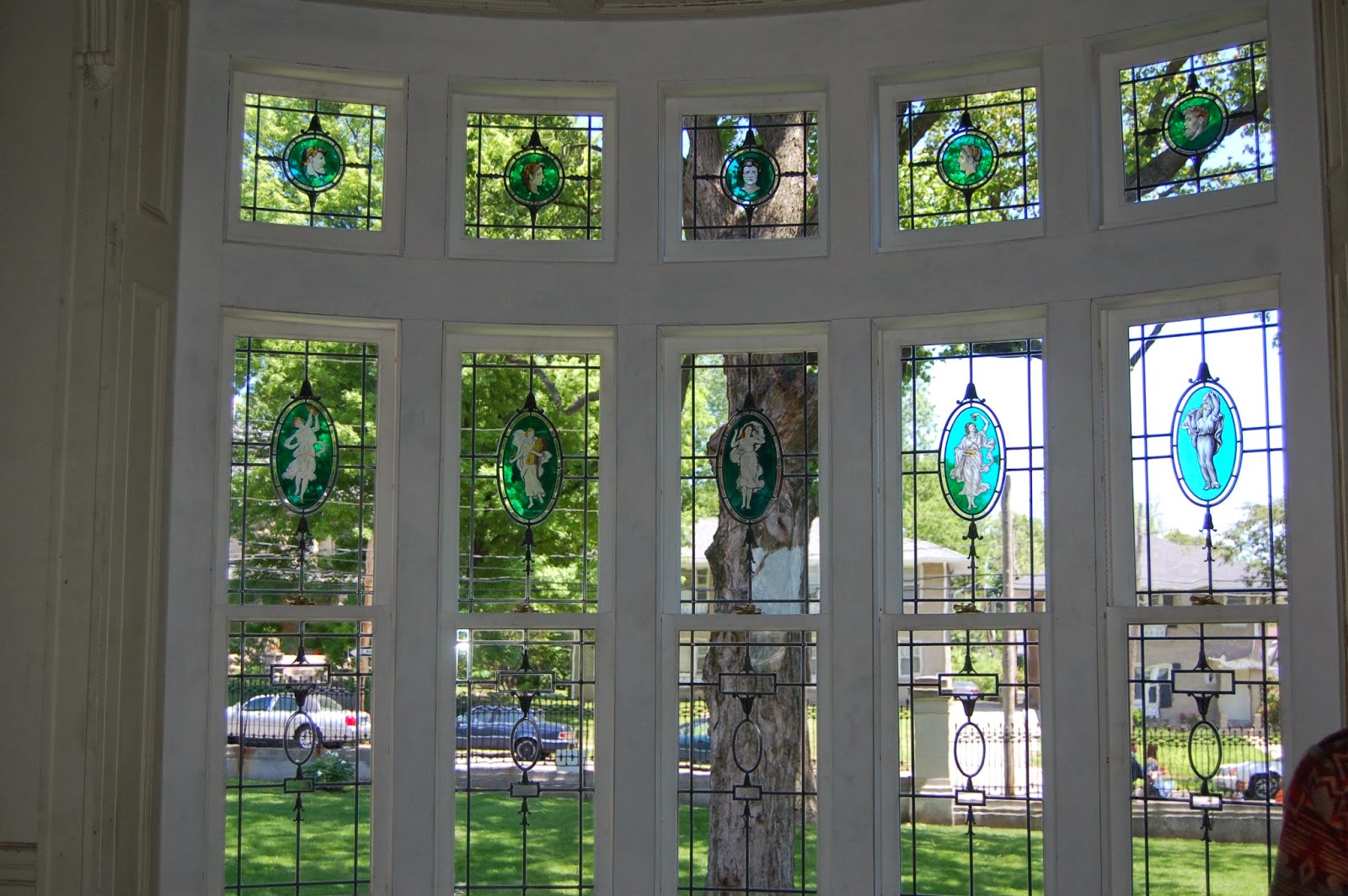
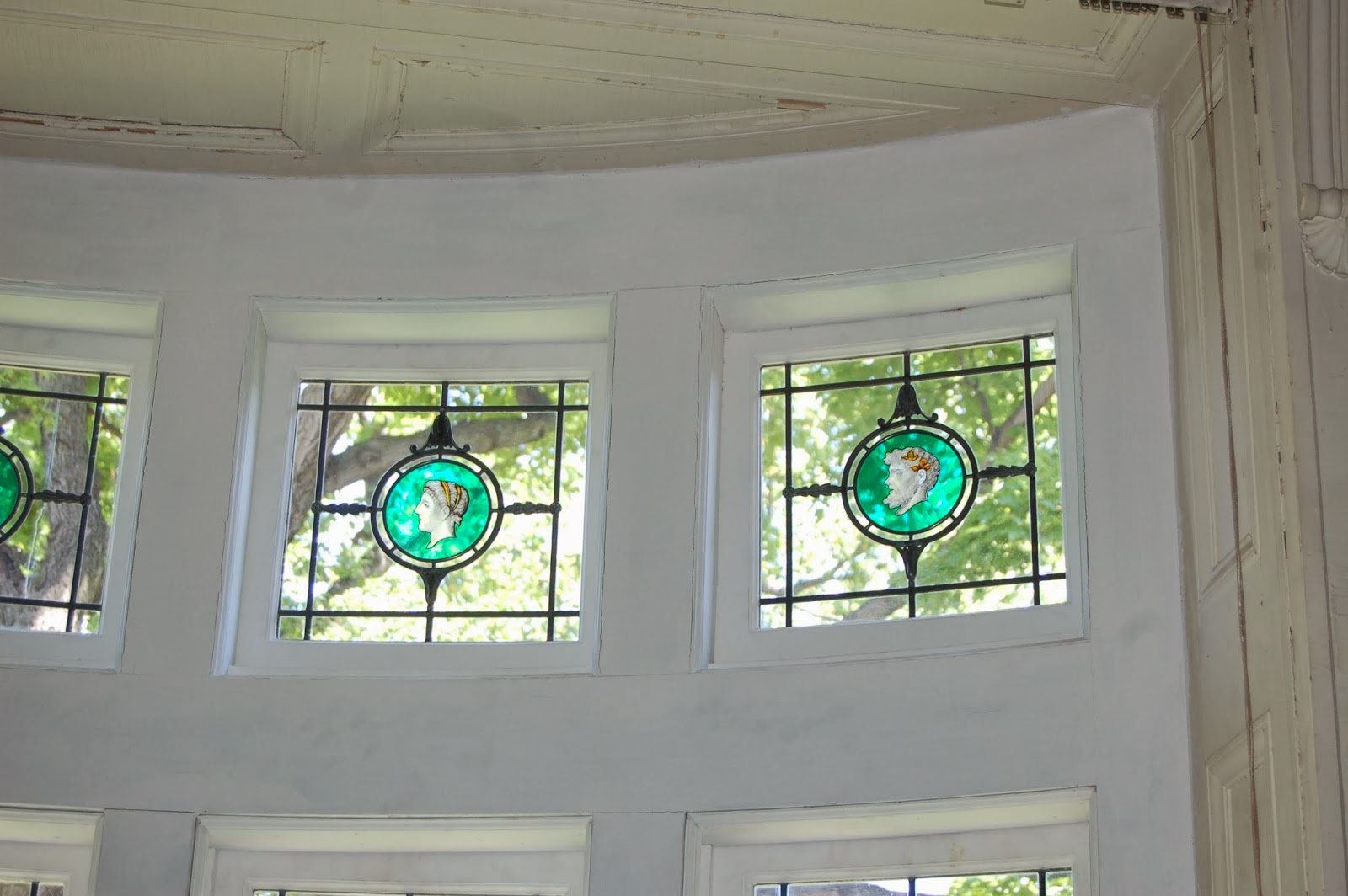
Stained glass bay window in the the dining room

Close up of stained glass bay window in the dining room

Close up of stained glass bay window in the dining room

Stained glass sunlight in sun room

Decorative corner moulding located in the Grand Salon

There's a fantastic timeline of the history of the museum on the Kansas City Museum's website but the short and sweet is that after Robert Long's death in 1934 the house sat empty until 1939 when the Kansas City Museum opened it's doors within the house.  The buildings and grounds were put on the National Register of Historic Places in 1980.  In 1999, the association which managed the museum merged with the entity which managed Union Station and in 2001 the two entities merged and incorporated.  In 2005, the museum embarked on it's current path of restoration from the museum of the 1950s-1980s back into the R.A. Long home known as Corinthian Hall.

Personally I'm very excited to see the restoration continue on Corinthian Hall.  I've watched the restoration as its moved through each of its phases thus far in the process and, while it takes a great deal of time, I'm confident that the results will be well worth the wait.

Museum admission is currently free while the renovations are going on.  Current hours can be found here.  There are some very interesting current exhibits to be seen during your visit and don't forget to check out their great adult and family programs that are currently available.

The few pictures I've included in this post are just a few of the gorgeous elements of Corinthian Hall.  Take a day to stop by and see this historic gem, take a hard hat tour, walk around the grounds and check out the beauty.  It'll be worth your time.

Thursday, October 31, 2013

Around the Town Thursday: Pirtle Winery

Welcome to another edition of Around the Town Thursday!  I'm very excited for today's post, for two reasons: first and foremost, it's a winery.  If that's not enough there's the second reason, it's a winery in a church building.  Oh but it gets better!  The old church Pirtle Winery resides in is a Lutheran Evangelical Church that was built by German immigrants.  Being Lutheran I find that very humorous.  So for me, it just doesn't get much better than that, LOL!  Until you get to the wine, that is.

Pirtle Winery
Weston, Missouri

Pirtle Winery has been open since 1978.  According to their About Us page, they've been family owned and operated since they opened.  What a great history to be able to claim.  Located in Weston, Missouri, they're a must stop on the Missouri Wine Trail.

Their wine line up contains the expected red and white grape varieties, but it also contains some fruit varieties such as apple, blueberry and cherry chocolate.  An unexpected treat that you'll find on their wine list is mead.  If you've never experienced mead, you should try it at least once.  What is mead?  The simple definition is that it's a wine made of honey.  Here's a good article on mead (courtesy of About.com).  While many wineries tend to stay away from mead, Pirtle embraces it.  There are currently three different types of mead listed for sale on Pirtle's website.  While I'm not personally a mead fan, I highly recommend stopping by to try Pirtle's mead (and other wines, of course).

When you stop in at Pirtle, allow yourself a little time to look around.  Pirtle has an indoor winegarden and wine bar (a new feature I haven't seen yet) which can be enjoyed but if you're there on a nice day, make it a point to buy a bottle of Pirtle wine, step outside to their vine-covered outdoor wine garden (located between the winery and press house), sit and enjoy the day and your wine.  You won't regret the time spent there.

Thursday, October 17, 2013

Around the Town Thursday: Christy's Tasty Queen

After having traveled to Hutchinson, Kansas to see some great sights, we're back in Kansas City for this edition of Around the Town Thursday.

Today we're stopping in at Christy's Tasty Queen, a great little hole-in-the-wall restaurant located in Kansas City, Kansas.

Christys Tasty Queen in Kansas City, Kansas
I grew up in the Turner District so Christy's was a staple for myself and other Turnerites.  They have the BEST tenderloins in the area.  But the tenderloins isn't the only great food at Christy's.  I love their burgers and their hot fudge sundae shakes.  D1 is a fan of their tenderloin (of course), which is the size of a small plate but well worth the price!

Christy's has been around since 1983.  It's not a sit down restaurant, though it does have one or two picnic tables you can sit outside and eat at.  Many reviews on Yelp and Foursquare have referred to it as a hidden gem and throwback restaurant.  I would agree with both statements.

Don't wait until you're in the area to stop at this excellent restaurant!  It's worth making a special trip to try the tenderloin and a shake.

Friday, October 11, 2013

Follow Friday: Ancestry Search


Welcome to another edition of Follow Friday!  Today I'm highlighting Ancestry Search, a family history blog written by Kathleen.  I admit, this one I started reading purely because the first post I saw was Kathleen's post on Researching in the Kansas State Census.  Anyone who knows me fairly well knows I love living in Kansas.  Not tolerate, not like but LOVE so anything Kansas (or Missouri since I was born there and spent many happy summers there) automatically catches my attention.

Enough of my rambling.  Focusing back on Kathleen's blog post about the Kansas State Census, she notes in her post an obvious mistake which was made during indexing two children on the census.  This is a great reminder that indexes (and enumerators) are only human and can make mistakes, thus checking AROUND the family you're looking for in the census records is always a good idea.

Kathleen's posts are just right in length (in my opinion).  I've said before that we genealogists have a tendency to ramble and get off on tangents (noooo, not us!) so a post that focuses and gets straight to the point catches my attention and keeps me reading.

And one last item of interest.  It was Kathleen's post on Reading County History Books - Clues in the Biographies that caused me to Google one of my ancestor's names and discover a Who's Who book that has been digitized for the area in which he resided.  The book is a collection of biographies of the longstanding citizens in the area he lived in and I was tickled to find him in there.  So a big THANKS to you, Kathleen, for writing that post!

Take a minute today and read just one of Kathleen's posts.  I think you'll find it worth your time.

Thursday, October 3, 2013

Around the Town Thursday: Strataca - Kansas Underground Salt Museum

It's Thursday, who else is excited for Friday eve?!  Another Thursday brings us to another Around the Town Thursday post.  Today we're looking at the Strataca - the Kansas Underground Salt Museum.

Entrance to the Visitors Center of the Kansas Underground
Salt Museum located in Hutchinson, Kansas

Once a year the Smithsonian Magazine hosts an event they call Museum Day Live! and on that day you can get free admission to one of over 1,500 museums that choose to participate for you and a guest.  It's not just Kansas that participates, this is a nationwide event with FaceBook and Twitter presences in addition to their website.  It's a fantastic event and makes me love Smithsonian Magazine that much more for hosting such an event.

This year D1 and I were actually free the day Museum Day was scheduled for so we decided to make a day of it.  D1 had been wanting to go to the Cosmosphere in Hutchinson for awhile so I signed up for a ticket for us.  Tickets are issued by household so at some point he decided to sign up for a ticket to the Salt Museum, also located in Hutchinson.  I was excited about going to the Cosmosphere but to find out that we'd be including the Salt Museum in our trip made my day.  It had been awhile since I'd been to the Cosmosphere but I'd never been to the Salt Museum.  And, oh!  A blog post to boot.  It doesn't get much better than that.

Hutchinson is about four hours away from Kansas City so we got up at really-stinking-early-o'clock in the morning to get to Strataca early enough for the first tour.  The museum is actually below ground...650 feet below ground to be exact.  The building that serves as the entrance actually doesn't hold much more than the ticket counter, waiting area, restrooms, locker area and tour prep areas.  The tour groups are limited to 28 people because of the capacity of the elevator down to the museum.  Even though you're assigned to a tour group, you're not actually tied to that group for the entire time you're in the museum.  The museum is self-paced once you get thru the initial tour guide introduction.

Large piece of salt mined in the Salt Museum

The museum website recommends allowing at least two hours for the museum experience.  You could spend far, far longer than two hours in this museum.  The exhibits are interesting, videos informative and staff friendly and knowledgeable.  The museum offers two excursion rides, each costing an additional fee after the purchase of the regular ticket (there are several different ticket options, including a Salt/Cosmosphere combo ticket).  The Train Ride and Dark Ride are absolutely worth the additional purchase.  As an added bonus to the great tours these rides provide, taking the Dark Ride gets you the opportunity to take home your own piece of salt from the museum.

D1 enjoying the Train Ride at the Salt Museum

Having fun at the Salt Museum!

I absolutely recommend going to see the Salt Museum!  Make sure you allow plenty of time so you don't rush through the museum.  If you have the time and money to do both rides in addition to the museum, go for it!  D1 and I both thought the rides were worth the price paid.  Be open minded when you go, it's not all about the mining process.  You also learn about the history of the mine, the people who worked in the mine, geology, and you even learn a little bit about post-mining storage facilities that work in conjunction with the mining operation.  Don't hesitate to ask questions, the museum staff is knowledgeable and ready and willing to answer them.

And the Strataca doesn't stop with the museum!  They have an events area (and often hold weddings, meetings, theater performances and other events there), different opportunities for Scouts, schools and kids in general and various special events, many of which sound like so much fun!

Take a day and go deep into Kansas...underground.

Monday, September 16, 2013

My Brick Wall: Sarah Ann (Craig) McKee

A brick wall.  Every genealogist has one at one time or another.  My genealogy is no different.  With Constitution Day being this week (September 17 to be exact) my thoughts have been centering on my brick wall.  You see, the Daughters of the American Revolution work very hard to celebrate Constitution Week (for obvious reasons) and, as I mentioned previously, I've been working very hard on gathering up genealogical proof for my application to join the DAR.  Thus, in a roundabout way, we arrive at my brick wall.  So a few basic facts:

Name: Sarah Ann (Craig) McKee (my third great-grandmother)
DOB: 20 February 1830
Place: Tippecanoe, Marshall, Indiana
Parents: William Craig and Katie Helms (nothing further known about parents)
Married: Ephraim Adams McKee
Date: 7 December 1848
Place: Danville, Vermilion, Illinois
Death: 13 May 1906
Place: Kansas City, Jackson, Missouri
Children: 6 (5 boys and 1 girl): John William (#1), John William (#2), Sarah Ann, John William (#3), George Washington and Robert Marion.

Sarah Ann (Craig) McKee
Photographer: Unknown
Year taken: Unknown

Now that we have the basic facts that have been proven through census and vital records, let's talk about the "myths and rumors" that haven't been proven yet:
  • Sarah Ann (Craig) McKee was married two other times, probably after marrying my 3rd great-grandfather, Ephraim Adams McKee.  Her other two husbands were William Coslet and Samuel Coslet (order of marriage unknown); a listing for a marriage between Samuel Coslet and Sarah A. Coslet has been located in the Illinois State Archives Illinois Statewide Marriage Index, 1763-1900 (marriage date of 7 August 1878, five years after the death of Ephraim Adams McKee).
  • According to my maternal grandfather, Sarah Ann was of Native American ancestry.  Though we're not certain of the tribe, Grandpa Edward always referenced "Tippecanoe and Tyler Too".  A little bit of research revealed that "Tippecanoe and Tyler Too" was a campaign slogan for William Henry Harrison and his running mate John Tyler in the 1840 presidential election (information courtesy of "The Meaning of Tippecanoe and Tyler Too").  In short it references Harrison's victory over the Shawnee tribe chief Tecumseh at the Battle of Tippecanoe in 1811.
  • Sarah Ann supposedly had enough Native American blood in her that she was granted some land in Mount Washington, Jackson, Missouri.  Research on the Bureau of Land Management General Land Office Records website under Jackson County, Missouri has proved fruitless for her name or Ephraim's name, the last name of Coslet or the last name of Craig but did bring up some other McKees.  Research on the area known as Mount Washington has turned up that it was the area that is now Mount Washington Cemetery in Independence, Missouri, where several of my family members are buried, including Sarah Ann (Craig) McKee (in a currently unmarked grave) and her daughter Sarah Ann (McKee) McCabe (also currently in an unmarked grave).
  • Further research has led me to believe that Sarah Ann could have been a member of either the Shawnee tribe or Potawattomie tribe due to dates and locations of Sarah Ann during her migration trail and the history of the removal of the Pottawatomie Indians from Indiana in 1838 via the Trail of Death (though the timeline is not the same, the migration trail is).  Again this could be completely off, as all I have are stories and not much in the way of solid evidence.
Let's look at a brief timeline of Sarah Ann's life.
  • 20 February 1830: Sarah Ann is born in Tippecanoe, Marshall, Indiana
  • 7 December 1848: Saran Ann marries Ephraim Adams McKee in Danville, Vermilion, Illinois
  • 1860: Sarah Ann is listed in the federal census with husband, Ephraim in Clinton County, Illinois
  • 1870: Sarah Ann is listed in the federal census with husband, Ephraim in Vance Township, Vermilion, Illinois
  • 16 January 1873: Sarah Ann's husband, Ephraim Adams McKee dies
  • 7 August 1878: Sarah Ann possibly marries Samuel Coslet in Douglas County, Illinois
  • 1880: a possible listing in the 1880 federal census of a Samuel and Sarah Coslet located in Bowdre Township, Douglas, Illinois
  • 1900: a possible listing in the 1900 federal census of a Sarah A. McKee, listed with one son named Edward, located in Allen, Noble, Indiana (I consider this a good possibility because the age is very close and the number of children living is exactly the same, it's questionable because I don't know of any son Edward but since she was married after Ephraim it could be a step-child)
  • 13 May 1906: Sarah Ann dies in Kansas City, Missouri
My current project with Sarah Ann is checking all the federal census records.  I've been unable to locate her on the 1890 census at all.  I'm not sure where she disappeared at in the 1890 census but searches for McKee, Coslet and Craig return nothing at all through HeritageQuest.  I plan to verify that search with Ancestry the next time I go to the library.  I haven't had the chance to check the 1840 or 1850 censuses at all yet.
 
My goal with this post is primarily to put the information out on the WWW in hopes that someone might have some information about Sarah and/or her husband, Ephraim and their daughter Sarah and/or her husband, Chester.  Secondly, it's my hope that someone, somewhere might be able to give me suggestions on where to look next to either prove or disprove these myths.

Wow brick walls can be frustrating!

Thursday, September 12, 2013

Around the Town Thursday: Amigoni Urban Winery

Welcome to another edition of Around the Town Thursday!  I'm excited about today's subject, Amigoni Urban Winery in Kansas City, Missouri's West Bottoms.

Amigoni Urban Winery


I love finding new wineries because that means wine tasting which equals finding new wines and that process is so much fun!  Amigoni was started in 1995 by the Amigoni family.  Their About Me page has a very nice history of the beginnings of the winery.

If you like dry wines then Amigoni is definitely the place for you to go.  While I'm not a fan of dry wines, I always like to try as many wines as I can when I go to a wine tasting.  Even if I end up not liking the wine I still want to try it, just in case, because you never know what you're going to end up liking.

So I visited Amigoni during my bachelorette party because a friend of mine, V, (insert shameless plug here) who makes fantastic beads was showcasing her beads at a show being held on Amigoni's grounds.  It was a winery I hadn't been to yet so the girls said what the heck and made it our first stop of the day.  Again, I'm not a fan of dry wines anyway but the crew in the tasting room was fun, perusing the wares at the show was a nice diversion and getting to see V was a bonus.  Little did I realize that the winery was actually housed in a historic location!

By now, no doubt, you've figured out I love history and all things historic.  The highlight of this winery visit for me was the building itself.  Amigoni is housed in the historic Daily Drover Telegram Building.  Constructed in 1909 the building was home to a livestock industry newspaper for 50 years.  Amigoni has obviously put a great deal of effort into returning the Daily Drover back to it's original glory.  The architecture, woodwork and tile are gorgeous.  It's definitely worth your time to go down to the West Bottoms to visit Amigoni.  Several of the girls at my bachelorette party enjoyed the wines there and the view isn't too bad either.


Thursday, August 29, 2013

Around the Town Thursday: Twelfth Street Viaduct Bridge

Welcome to another Around the Town Thursday!  Now I know what you're thinking: "A bridge??  You're writing about a bridge??"  But this isn't just any bridge.  Today I'm highlighting the Twelfth Street Viaduct Bridge in the West Bottoms of Kansas City, Missouri.

Mid-level of the Twelfth Street Viaduct Bridge
Native Kansas Citians will recognize this bridge as being down near all the popular haunted houses and the American Royal.  But the bridge has a very interesting history.  Created to be a link between the business district and the industrial district of Kansas City, Missouri, the Viaduct was created by the great minds at Waddell and Harrington (a Kansas City architecture firm) in 1915.  It is one of the earliest examples of a double-decked, reinforced concrete bridge.  The upper level goes from the Central Business District to the West Bottoms.  The lower level goes into Westside, which contains a variety of restaurants and shops.  And below the bridge...well below the bridge are the original cobblestone street farmers would travel back in the day when the bridge was still young.

View from the lower level of the Twelfth Street Viaduct Bridge

Architectural & Historic Research, LLC has a fantastic piece on their website titled "An Historical Perspective of Kansas City's Twelfth Street Trafficway Viaduct 1911-1915" (written by Cyndy Millstein) that contains a ton of great information about the history of the Viaduct and the architects that built it.  There's also a brief history of the bridge on the Historic West Bottoms website.

A very interesting piece of information I discovered during the researching of this post: you can rent the bridge for events.  Weddings, parties, and other events can be held (for a price) either on the lower level or below the bridge on the cobblestone street.  How fun!  I'm not sure how I missed THAT venue for my wedding in June but D1 definitely had a bit of venue envy when I told him the bridge could be rented for events.  You can find rental information for the bridge here.

And just because I can, I'm going to throw a little spotlight my dear husband's way.  In 1997, the music group U2 did a music video here in Kansas City for their song "Last Night on Earth".  The video producers were looking for some old, run down cars for the video and D1 was (and still is) the proud owner of a 1972 Chevy Chevelle.  Said Chevelle ended up in that video as an "extra" (the music video can be viewed on Dailymotion).  At 2:33 if you look past the open truck door to the next car bumper, that bumper belongs to D1's Chevelle. And then again at 2:40 if you look through the rear view window of the car being driven down the bridge you can see some round taillights of a car.  Those taillights belong to D1's Chevelle as well.  It's a memory D1 smiles about each time he tells the story.

It was fun to take a drive down the bridge for pictures for this post.  If you're planning to go see the bridge I would strongly suggest going on a Sunday evening, around 4:00pm or so because there's hardly any traffic at all.