Showing posts with label National World War I Museum. Show all posts

Thursday, November 28, 2013

Around the Town Thursday: The Money Museum at Federal Reserve Bank of Kansas City

Happy Thanksgiving everyone!  We've got a nice little post for you to read while you're enjoying your good food.  Today we're peeking in at The Money Museum at Federal Reserve Bank of Kansas City.

The Federal Reserve Bank of Kansas City
The Money Museum is located inside the Federal Reserve Bank

The Money Museum gives visitors the opportunity to watch millions of dollars of currency be processed, check out some interesting exhibits and learn about the economy all in one visit.  And the best part of all of this is that it's free to view!

Reservations are not required to tour this museum for groups of 20 or fewer but you will need to go thru a security screening to get in.  You can sign up for a guided tour for groups of 15 or more.

Hours of operation, parking and accessibility information and information regarding security screening can be found here for the museum.  For a little prep for your tour you can check out highlights of the Money Museum here.  The museum recommends approximately one hour to complete the self-guided tour.  It's right next door to the National World War I Museum at the Liberty Memorial, however, so you can make a day of it and tour both museums!

This museum is definitely worth your time, so make plans to go learn all about the economy and the currency process at The Money Museum at Federal Reserve Bank of Kansas City.

And make sure to stop by next week for a very special Around the Town Thursday post!  We definitely won't be in Kansas anymore!

Monday, November 11, 2013

Lest We Forget: The Poppy

Today is Veterans Day and today's post is dedicated to all those who have served and all those who are currently serving.  Thank you all for your service and sacrifice!

Today being Veterans Day, you may notice that some people are wearing poppies today.  Do you know the significance of the poppy on Veterans Day?  Originally, the poppies were only worn on Memorial Day but many groups have opted to also wear the poppies on Veterans Day (also known as Remembrance Day).  Veterans Day honors all those who served in the military, whether in wartime or in peacetime.  It falls on the day the World War I hostilities officially ended, "at the 11th hour of the 11th day of the 11th month" in 1918.  But why poppies?

The significance of the poppy goes back to World War I and the poem "In Flanders Fields" written in 1915 by Lieutenant Colonel John McCrae, a Canadian physician who served during World War I.  McCrae wrote the poem after presiding over the funeral of a friend and comrade.

In Flanders Fields the poppies blow
Between the crosses, row on row
That mark our place; and in the sky
The larks, still bravely singing, fly
Scarce heard amidst the guns below

We are the Dead.  Short days ago
We lived, felt dawn, saw sunset glow,
Loved, and were loved, and now we lie
In Flanders fields.

Take up our quarrel with the foe:
To you from failing hands we throw
The torch; be yours to hold it high
If ye break faith with us who die
We shall not sleep, though poppies grow
In Flanders fields.

Flanders fields refer to World War I battlefields in an area near Belgium which is now known as West Flanders, East Flanders and part of the French region of Nord-Pas-de-Calais.  The Second Battle of Ypres occurred here, which is the battle that McCrae's friend died in and helped to prompt the writing of "In Flanders Fields".  After all the devastation on these battlefields in World War I, poppies began to bloom in the battlefields.  The only thing that could survive in the devastation, the poppies were able to bloom due to the fact that they are a plant that thrives on disturbed ground.  The seeds lie dormant until the soil is broken up, and then the flowers take root and begin to grow.

After writing the poem, it was submitted to newspapers in England.  It was rejected by The Spectator but published by Punch on 8 December 1915.  The poem was read by Moina Michael, an U.S. professor and humanitarian, who was so moved that she wrote the poem "We Shall Keep the Faith" in reply to McCrae's poem:

Oh! you who sleep in Flanders Fields,
Sleep sweet - to rise anew!
We caught the torch you threw
And holding high, we keep the Faith
With All who died.

We cherish too, the Poppy red
That grows on fields where valor led;
It seems to signal to the skies
That blood of heroes never dies,
But lends a lustre to the red
Of the flower that blooms above the dead
In Flanders Fields.

And now the Torch and Poppy Red
We wear in honor of our dead.
Fear not that ye have died for naught;
We'll teach the lesson that ye wrought
In Flanders Fields.
In Flanders Fields we fought.

According to the American Legion Auxiliary Poppy site, in November 1918 on an impulse, Moina Michael purchased all the poppies that New York City's Wanamaker's Department Store had in the store and handed them to businessmen meeting at the YMCA where she worked and asked them to wear the poppy as a tribute to the fallen.  The idea of selling silk poppies is credited to Michael as a way to raise funds to assist disabled veterans.  In 1921, the American Legion Auxiliary adopted the poppy as a symbol of remembrance for war veterans.

And now you know the story of the poppy.

Lest we forget.

Thursday, November 7, 2013

Around the Town Thursday: Kansas City Museum at Corinthian Hall

It's Thursday and time for another edition of Around the Town Thursday.  In the spotlight today is a historic building that's very near and dear to my heart: Corinthian Hall.

South facade (front) of Corinthian Hall

Porte cochere with bronze and wire glass canopy

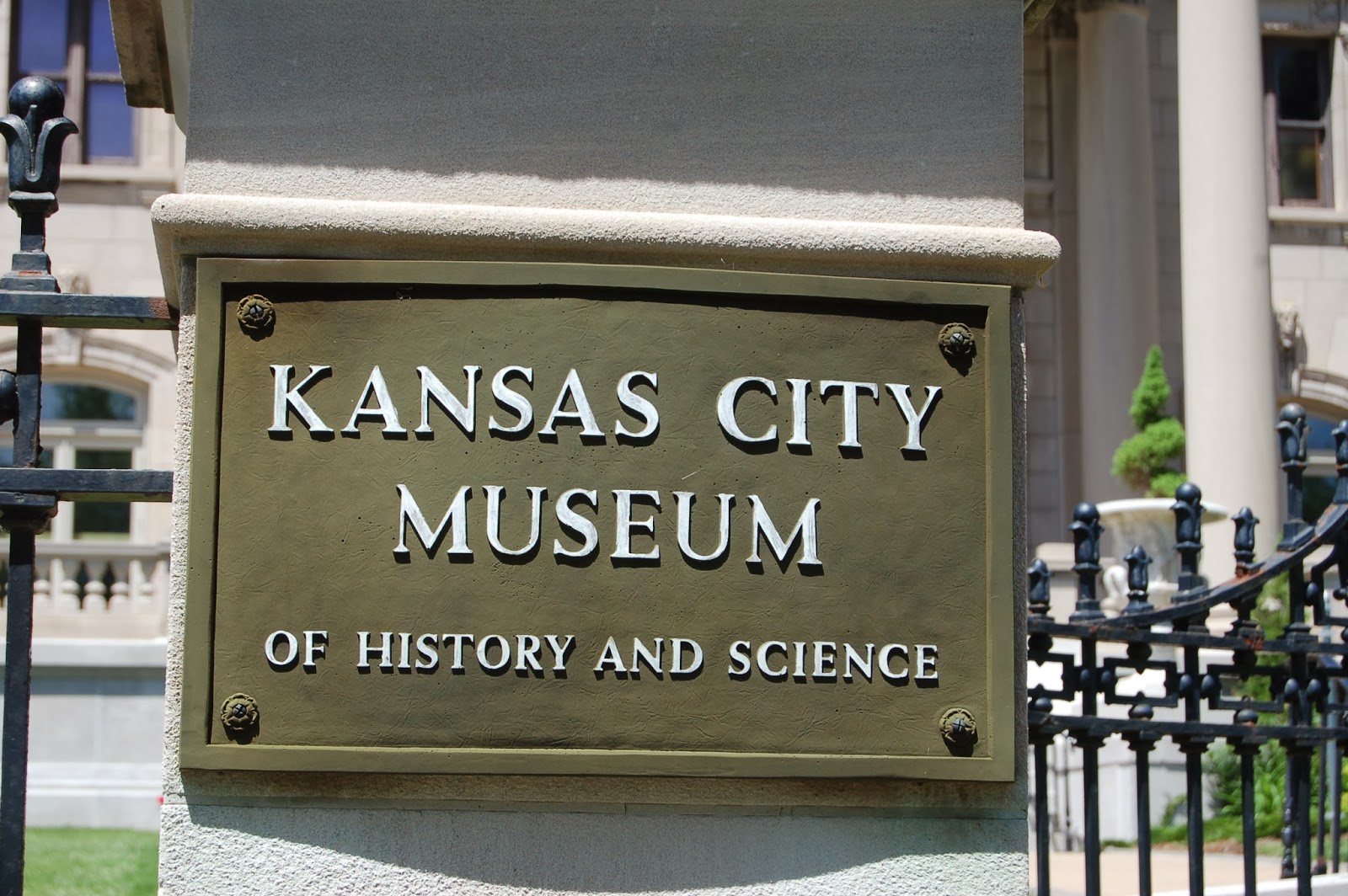
Many local residents might know this building as the Kansas City Museum of History and Science, which it did house for many years.  


Many Kansas Citians may remember such icons as the igloo on the third floor, the covered wagon on the first floor and the tepee display on the first floor of the museum.  And who could forget the Natural History Hall housed in the carriage house which was full of stuffed animals contained in lifelike dioramas of natural habitats of each animal.  I'm sure many of us remember the bear at the end of the hall!

But what many visitors of this hallowed institution may not know is the fabulous history of this building and its residents.  Kansas City has a wonderful history tied directly to the builder of this home: Robert A. Long.

Robert A. Long was many things but he's most well-known in the Kansas City area for being a lumber baron, philanthropist and driving force behind the Liberty Memorial (now known as the National World War I Museum at the Liberty Memorial).  He was also instrumental in the building of several other buildings in downtown Kansas City, Missouri.

According to the Friends of Kansas City Museum at Corinthian Hall website, "Corinthian Hall, one of Kansas City's larges and most well-known residences, began its life not as a plan for a mansion, but as a plan for a stable."  According to Robert Long's daughter, Loula Long Combs, Robert saw the need for a new stable and decided the family should also have a new home to go with it.  That decision lead to the creation of Corinthian Hall.  Referred to as Corinthian Hall because of the six Corinthian columns located in the front of the house, Corinthian Hall boasted approximately 50,000 square feet of space which was broken down into three floors containing approximately 70 rooms and closets, 15 bathrooms, nine fireplaces, an attic and a basement containing a full-length bowling alley.  The home was completed in 1910 and the Long family resided there until Robert Long's death in 1934.

The building is absolutely gorgeous on the outside and inside.  Right now, with the restoration going on, you have to enter the grounds from the North side of the grounds.  But oh!  What an entrance.  If you happen to go during the spring and summer the wisteria may very well be in bloom on the pergolas and its so pleasant to just be able to sit on a stone bench, under the wisteria-covered pergolas and enjoy the shade and beauty of the grounds.

North entrance of the grounds partially showing the pergola and wisteria

Pergola and wisteria at Corinthian Hall

Access to Corinthian Hall is currently restricted to hard hat and guided exhibit tours.  I can't recommend the hard hat tour enough.  It's a great tour and gives visitors a great deal of insight into the history and current renovations going on.  You can see where the renovations stand now, hear about previous phases of the renovations and learn about future plans for the museum.  The stained glass, original walls and floors, grand staircase and other fancy bits are a beauty to behold, even now during renovations.  One can only imagine what the grandeur might be like when the renovations are complete.  Information on the hard hat tours can be found here.

Grand Staircase

Beautiful stained glass window at the top of the Grand Staircase

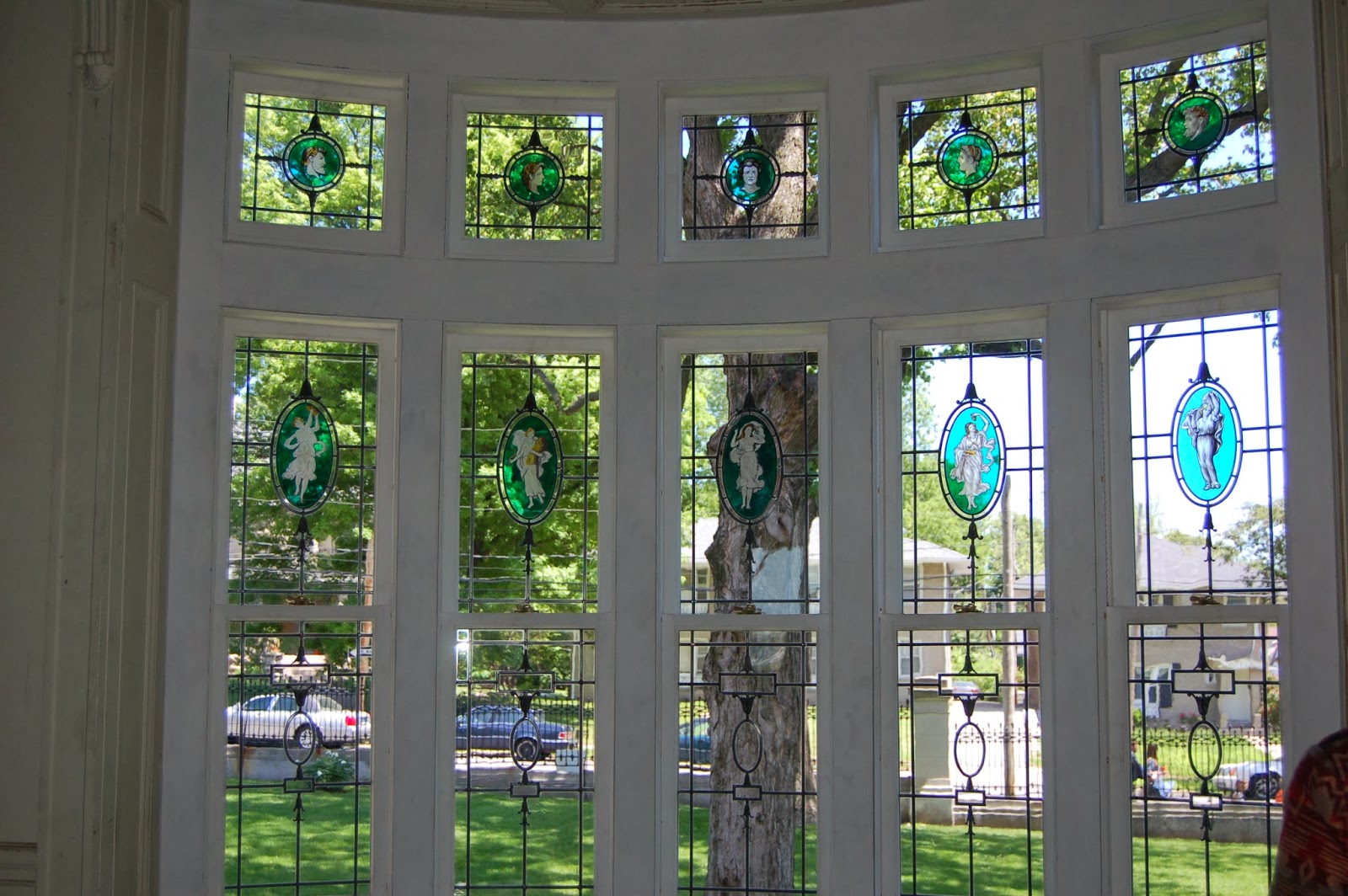
Stained glass bay window in the the dining room

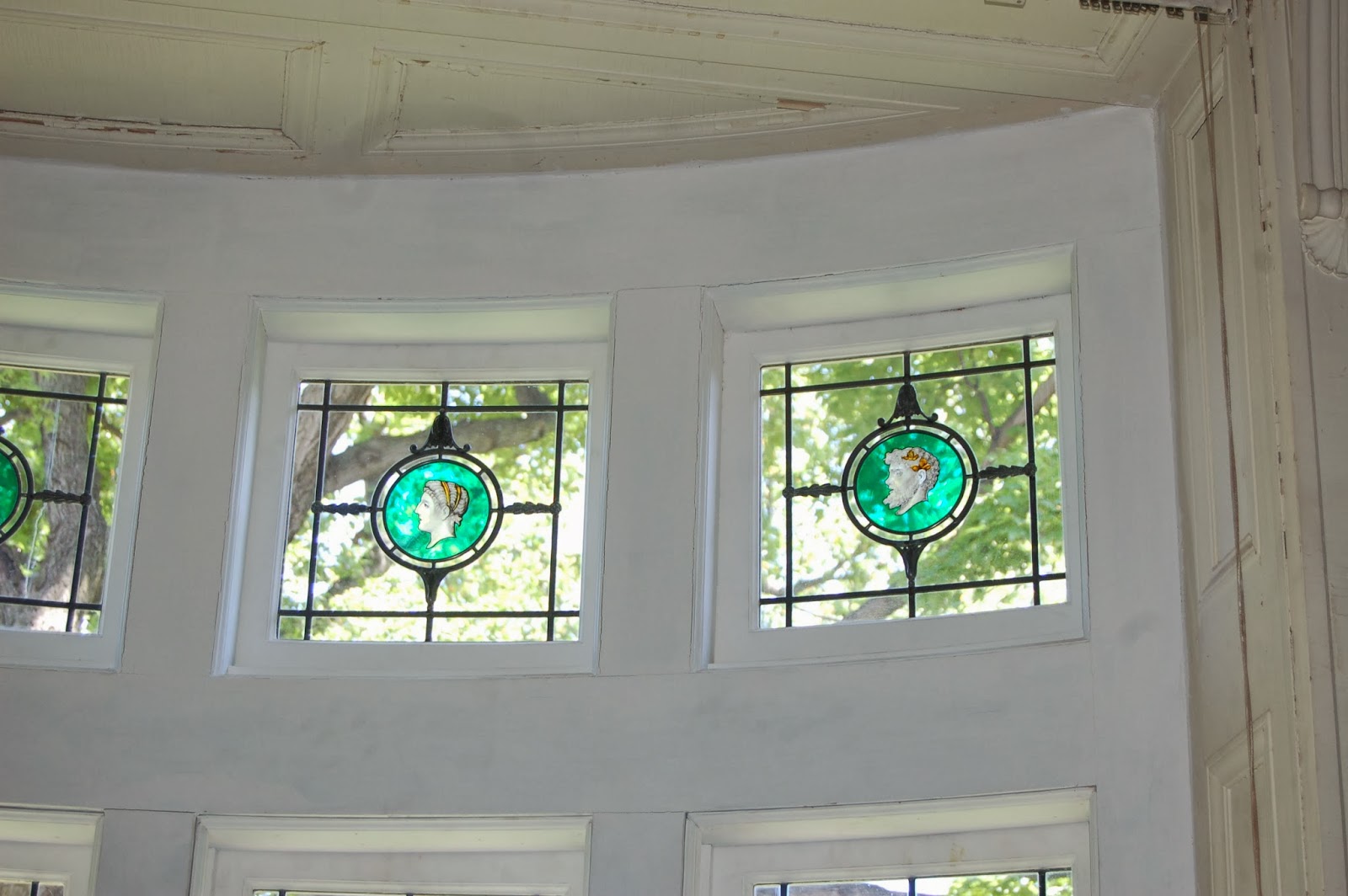
Close up of stained glass bay window in the dining room

Close up of stained glass bay window in the dining room

Stained glass sunlight in sun room

Decorative corner moulding located in the Grand Salon

There's a fantastic timeline of the history of the museum on the Kansas City Museum's website but the short and sweet is that after Robert Long's death in 1934 the house sat empty until 1939 when the Kansas City Museum opened it's doors within the house.  The buildings and grounds were put on the National Register of Historic Places in 1980.  In 1999, the association which managed the museum merged with the entity which managed Union Station and in 2001 the two entities merged and incorporated.  In 2005, the museum embarked on it's current path of restoration from the museum of the 1950s-1980s back into the R.A. Long home known as Corinthian Hall.

Personally I'm very excited to see the restoration continue on Corinthian Hall.  I've watched the restoration as its moved through each of its phases thus far in the process and, while it takes a great deal of time, I'm confident that the results will be well worth the wait.

Museum admission is currently free while the renovations are going on.  Current hours can be found here.  There are some very interesting current exhibits to be seen during your visit and don't forget to check out their great adult and family programs that are currently available.

The few pictures I've included in this post are just a few of the gorgeous elements of Corinthian Hall.  Take a day to stop by and see this historic gem, take a hard hat tour, walk around the grounds and check out the beauty.  It'll be worth your time.

Friday, September 27, 2013

Follow Friday: A Sense of Family


Friday, hooray!  Let's take a look at today's edition of Follow Friday.  A Sense of Family is the blog I've chosen to spotlight today.

Shelly's posts are easy and interesting reads.  She's highlighted her family, conferences she's attended, genealogical writing and tips and tricks that she uses.  Her post on Finding Daughters by Searching on Father's Name: Tuesday Tip was especially interesting.  I hadn't thought of using that technique before; I just love learning new things!

Shelly's post on Visiting the American Cemetery at Normandy also struck a chord with me.  Having decided at the beginning of the year to start volunteering at the National World War I Museum here in KC, my interest in World War I has increased exponentially.  Normandy is a place I would love to see, just because of my interest in World War I.

So take a minute today and check out A Sense of Family, I bet you'll find something that interests you there.

Monday, September 9, 2013

Ah Those Genealogy Tangents

I typically spend my weekends as most others do: running errands, working around the house, watching a little t.v. and other mundane tasks that never seem to get done during the week.  But I also allot a bit of time to indulge in things that I enjoy doing and might otherwise get pushed to the side if I didn't allot some specific time to these items.  Genealogy is one of those things.  Volunteering at the National World War I Museum is another.  Last weekend, those two things came crashing together.

I've been working on a goal as a volunteer at the museum.  I really want to work in the museum's research center.  I mean, what genealogist or history junkie wouldn't want to spend four hours or more surrounded by history of that magnitude and have the ability to help a stranger discover new and interesting information?  My other goal is to step out of my quiet little comfort zone box and take a place among the interpretive corps of the museum.  Yep, I'm challenging myself to step in front of a group of strangers and guide them through the museum and do it so well that they're excited to spread the news about what a great museum the went to.  Ah, but I digress.

So each weekend I'm putting in my volunteer hours, walking the corridors of the museum, learning as much as I can and talking to visitors who come in.  Many have stories of relatives that served and in speaking to one person I had the sudden realization that I had a World War I draft card for my paternal great-grandfather, Ludwig Altman, in my possession that I hadn't done a darn thing with.  Whoa.  Stop the crazy train because I need to get off for a minute and check this out.  It was one of those moments that I really just wanted to headdesk myself because here I was, volunteering at a World War I museum that actually HAD a research center in the basement and I had neglected to check out this piece of information?  As Bill Engvall would say, "Here's your sign."

World War I Draft Card for Ludwig Wilhelm Altman

So this past week I took a couple of minutes and composed an email to the research center staff at the museum requesting to know if I was able to provide the information from the draft card if they had the resources to look and see if my great-grandfather had served?  The answer was yes so I forwarded the information to them and one of the kind volunteers was able to assist me in discovering that Ludwig had not served in the war.  He was (in my mind, quite unfortunately) too old to fight but still young enough to be required to fill out a draft card.  He was also the only provider for my great-grandmother Ida.  A little disappointed that I would get no military file from Ludwig, I thanked the volunteer for their assistance and began to move on my merry way to other things.  It only took a few minutes for me to begin kicking myself.  Was I really giving up THAT easily?  Surely somewhere in the family members I knew of that currently existed on my family tree there was someone, somewhere that had served during World War I?

Thus began my latest genealogy tangent.  Oh how easy it is to get distracted from what you're doing on one line when you make a new discovery.  I decided I wanted to follow this tangent.  It was a project that was, most likely, short-lived.  It had a definite beginning and a definite ending and, potentially, wouldn't take too much time to complete.  I probably never would have attempted this project at this point if it wasn't for the existence of a timeline view in my handy-dandy little iGadget app MobileFamilyTree.  If you remember, I've been playing with MobileFamilyTree for a bit and did a review of the app here.  One of the features the app has is a timeline view, which worked great for my needs on this project.  I decided to begin by looking for people who would have been 18 years old when the U.S. entered the war in 1917.  I knew there were younger people who volunteered earlier in the war but I just needed a place to start.  Inputting that criteria into the app gave me the following view:

Time frame selection for timeline view
 
Final result of timeline view using the period 1880 to 1896
 
Now THERE'S a list!  Everyone in my family tree that was born from 1880 to 1896 and would have been 18 in 1917.  I know you can't see the list very well, that's okay, I just wanted to give you an idea of what the app's timeline view would look like.  The work of paring that list down wasn't terribly difficult either.  I went through the list, removing the females (because, let's face it, they're not highly likely to be in the military records) and those who were deceased or just born within those years.  That got me a very manageable list.  I believe I was looking at about 12 men.
 
A sampling of individuals from my timeline view

I then went to the Mid-Continent Public Library and logged onto their Ancestry database and began systematically checking each person's name in just the military section of Ancestry.  I managed to find draft cards on almost all of them.  Unfortunately most of the eligible family members were claiming exemptions, so I suspect they won't have served during the war.  I am happy to report that I found a couple of good possibilities for war service, however, and will be checking with the research center very soon to see if anything pans out with any of the draft cards I located.  Writing them off completely without verifying the fact that they have no service record would just be ridiculous, especially considering how easy it was to verify that great-grandpa Ludwig didn't serve in the war.

So stay tuned, this is a project I hope to have completed in the next week or so and I'll be sure to update you on my findings.  On a side note, I was talking to my new brother-in-laws about my findings this weekend and PhotoGuru got very excited and said their family had some very interesting things pop up in their family tree when he traced their family history.  Um, really?  How did I not know that PhotoGuru had done this???  Funny how no one thought to mention that to the obsessed genealogist who was entering the family until now, LOL.  So with any luck, PhotoGuru will gather up that information he discovered (along with some other rather interesting findings and information he talked about) and I can get on working on those elusive Newell ancestors.

Have a great week everyone!

Thursday, July 25, 2013

Around the Town Thursday - Liberty Memorial

Welcome to Around the Town Thursday!  Around the Town Thursday is a way for me to highlight interesting, fun or useful places around my beautiful hometown of Kansas City.

In the spotlight today is one of my favorite places: The National World War I Museum at Liberty Memorial.

Liberty Memorial (during maintenance)

The National World War I Museum at Liberty Memorial is the United States' one and only World War I museum.  It was that way from the beginning and in 2004 the Memorial finally got designated by Congress as the nation's one and only official World War I museum.  The official museum website has a great brief history at the Museum and Memorial page but, in brief, Kansas Citians rallied after the war ended to memorialize the sacrifices made by those who served during The Great War.  In a mere 10 days, Kansas City raised over $2 million to create this memorial.

The Memorial suffered after many years and fell into disrepair and was eventually closed due to dangerous conditions in different parts of the Memorial.  But in 1998, Kansas Citians rallied once again, this time to save the Memorial.  Restoration of the Memorial began and the Memorial was re-opened to the public in 2006 at a grand celebration.

I was just 29 years old when the Memorial was scheduled to re-open on May 25, 2002.  My son was twelve that year.  On a whim, we got in the car the day of the re-dedication and went to watch the festivities.  Many famous people were there making speeches, Boy Scouts and Cub Scouts paraded around the circle drive along with military units, retired military and many local bands.  And I believe, if my memory serves me correctly, it was even attended by one of the last surviving World War I veterans at that time.  Little did I realize that was to be the beginning of my fascination with the Memorial.  I have since begun volunteering at this wonderful museum.  It's amazing to be surrounded by so many fantastically preserved artifacts.  The amount of information housed in the museum is overwhelming at times.  I learn something new every time I work a volunteer shift.

The Memorial was built in the style of Egyptian revival.  There are two sphinxes on the deck of the Memorial and four Guardian Spirits which circle the Memorial tower.

One of the two sphinxes on the Memorial deck
 
One of the four Guardian Spirits on the tower

One of two satellite exhibit buildings. These were original to the Memorial.
And if that's not impressive enough, the Liberty Memorial is home to one of the most unbelievable pieces of artwork ever created.  Many people aren't aware of it's existence until they're introduced to it at the museum.  Housed in the two satellite exhibit buildings of the Liberty Memorial are pieces of the great Pantheon de la Guerre.  You can read more about the Pantheon de la Guerre here but essentially the Pantheon was a huge (and I mean HUGE) mural painted during the War.  It was so large, it was housed in its own building after it was finished and it was a mural that required one to walk around it to see it all.  402 feet around and 45 feet high, I'll bet it was a sight to behold when it was whole.

Long story short, the Pantheon traveled to the U.S. for exhibition at a World's Fair, was forgotten after the fair, resided outside a storage facility for years until it was finally auctioned off.  Purchased by a Baltimore, MD man, William Haussner, it wasn't until 1957 that a Kansas City artist, Daniel MacMorris, was able to convince Haussner to donate it to the Memorial.  Because of MacMorris' efforts, the Pantheon is now preserved at the Liberty Memorial and is an amazing testament to the patriotic efforts of many French painters.

The last item at the Memorial to be highlighted is a little known gem: the research center.  There are over 75,000 archival documents and over 8,000 library titles housed in this research center...all for use for free by anyone who may be interested.  There is a research center attendant available to assist you on-site but the research center staff are the only ones with access to the archival collection so they do request that anyone wishing to view items from the archival collection make an appointment with the staff.  More information on the research center can be found here.  The research center is located on the bottom level of the museum building.  Even if you don't plan to visit the research center, make it a point to go to the bottom level, where you can get a unique view of the poppy field which resides under the glass bridge to the main gallery.  You can also get a view of the base of the tower.
  
A view of the poppy field from the glass bridge on the main level

Another rarely viewed jewel of the Memorial is the Great Frieze on the north wall of the Memorial.  Many people simply don't take the time to walk down the stairs at either side of the deck to see this beautiful carving.  Keep walking all the way down past the Great Frieze to Pershing Road in front of the Memorial and you'll get to see the bronze busts of the five Allied leaders present during the original site dedication.
 

There is so much to see and experience at the National World War I Museum at Liberty Memorial.  I highly recommend taking advantage of the fact that the ticket is good for two days.  The cost of the ticket is well worth what's there.  Before going I recommend looking at their website so you have an idea of what to expect.

Happy exploring!